Importance of Baptism in the Holy Spirit — Ralph Martin

PicMartinRalphThe 40th anniversary of the Catholic Charismatic Renewal and our 40th anniversary in The Word of God have led me to go back to think and pray and study the Scriptures again to see what I really think about this thing that we call “Charismatic Renewal”. We have also just celebrated the feast of Pentecost which was originally a Jewish feast. They gathered together to celebrate harvest, the first fruits, and also celebrate the giving of the law on Mt. Sinai. It is very significant that Jesus fulfilled his promise to baptize in the Holy Spirit on the Jewish feast of Pentecost because it’s the way of the harvest, the first fruits that are coming to birth, the church coming to birth. It also points to the law which is now being placed in the heart, the fulfillment of all those prophecies about the Lord putting his own Spirit, his own heart, his own law into our hearts so that nobody would need to say to their neighbor ‘know the Lord’ but everybody would know the Lord. Pentecost is the name the feast on which something happened. It doesn’t really tell us WHAT happened. What happened was that the disciples were baptized in the Holy Spirit. That’s the substance of what happened on the day of Pentecost. So when we celebrate Pentecost, what we are really celebrating is people being baptized in the Holy Spirit. This is the language that really Scripture uses. This is the language that each of the four Gospels use, John the Baptist uses, Jesus uses, Peter, the apostle, uses. This is what they described happened on the day of Pentecost people got ‘baptized in the Holy Spirit’.

The New Testament takes the issue of being baptized in the Holy Spirit very seriously. In Matthew 3, John the Baptist is preaching and he’s a little ticked off at the Pharisees and Sadducees coming to get baptized because he doesn’t believe they are sincere. He says don’t presume to say ‘we have Abraham as our Father, for I tell you God can raise up children to Abraham from these stone. Even now the ax lies at the root of the trees. Therefore every tree that does not bear good fruit will be cut down and thrown into the fire. Mt 3:9-11 This is kind of tough language! It says your repentance had better be sincere. If you claim to be turning away from sin and turning towards God but it’s not sincere, you are going to be cut off and thrown into the fire!

Now we know that John the Baptist was kind of rough around the edges, we know he lived in the desert, and this was his language. But Jesus adopts the same language. In John’s gospel, chapter 15, he says those of you who are bearing fruit will be pruned so you can bear more fruit. Those who aren’t bearing the true fruits of repentance, those who aren’t bearing the true fruits of Christian life, those whose faith really isn’t being expressed in good works and charity are going to be cut off and thrown into the fire! So this language of John the Baptist is being taken up by Jesus. This is kind of serious stuff!

Baptism in the Spirit is a serious issue The Word of God is a serious Word – it is about life and death, it’s about heaven and hell, it’s about salvation and condemnation and it makes a difference how you respond to this Word and how you live in accordance with it. John goes on to say ‘I am baptizing you with water for repentance, but the One who is coming after me is mightier than I. I am not worthy to carry his sandals. He will baptize you with the Holy Spirit and fire. His winnowing fan is in his hand. He will clear his threshing floor and gather his wheat into his barn, but the chaff he will burn with unquenchable fire.’ (Matt 3:11-12) So there is an apocalyptic, eschatological dimension to this whole issue of the baptism in the Holy Spirit. This pouring out of the Holy Spirit is intended to cleanse the human race, that those who receive the cleansing, those who receive the purifying will bear fruit and be gathered like wheat into the Lord’s barn. But those who resist the purification, those who resist the cleansing, those who resist the Spirit run the risk of being thrown into the unquenchable fire because they’ve dried up and don’t bear fruit.

Something more is needed Now Jesus, himself, uses several terminologies to talk about what’s going to happen. Sometimes he talks about the promise of the Father, sometimes he talks about being baptized in the Holy Spirit, and sometimes he talks about being clothed with power from on high.

Then he opened their minds to understand the Scriptures. And he said to them thus it was written that the Messiah would suffer and rise from the dead on the third day and that repentance for the forgiveness of sin would be preached in his name for all the nations who came from Jerusalem. You are witnesses of these things. And behold I am sending the promise of my Father upon you, but stay in the city until you are clothed in power from on high. Luke 24:46-49

Despite having three years of the best teaching that anybody could ever have, besides having personal attention and personal spiritual direction, personal formation from Jesus, and despite being instructed by Jesus in his resurrection appearances, and despite having seen the Risen Lord -- Jesus said ‘you are not ready yet’. There is something else that has to happen. You could know everything, you could have seen everything, you could be witnesses to the Resurrection, but something else has to happen to make it all come together. So wait until that happens, and what you need is to receive the promise of the Father.

Acts 1:3 says, “He presented himself alive to them by many proofs after he had suffered.” Jesus spent time with the Apostles after rising from the dead, appearing to them during forty days and speaking to them about the word of God -- more teaching, more explanation. Remember, Jesus would say something and the Apostles would say ‘we don’t get that, Lord, could you explain that to us in plain language’. So Jesus would explain it to them in plain language. They got A LOT of teaching, they got a lot of instruction, but it wasn’t enough to carry out the mission.

When Jesus met with them he enjoined them not to depart from Jerusalem but “to wait for the promise of the Father about which you have heard me speak”. “John baptized with water, but in a few days you will be baptized with the Holy Spirit” Acts 1:5. This is the language of Jesus. When they had gathered together, they asked him ‘Lord, are you at this time going to restore the kingdom of Israel?’ So even despite the Risen Lord explaining things to them, they still don’t get it. They said ‘Are you going to throw the Romans out now -- should we get our weapons now? are you going to throw them out now? So having three years of instruction wasn’t enough, seeing the miracles wasn’t enough, seeing the risen Lord and being taught by him for forty days wasn’t enough.

Jesus said ‘don’t get into this end time speculation, focus on your task. “It’s not for you to know the times or the seasons that the Father has established by his own authority but you will receive power when the Holy Spirit comes upon you and you will be my witnesses in Jerusalem, throughout Judea and Samaria and to the ends of the earth.” Acts 1:7-8 So don’t worry about that kind of stuff. I told you what you need to know but what you need to do now is receive the power of the Holy Spirit, be baptized in the Spirit and get on with the mission that I’ve given you to do and let the Father take care of those other things. So then they waited and they prayed. And then it happened – the day of Pentecost.

This is it When the time for Pentecost was fulfilled, they were all in one place. Suddenly a sound like the blowing of a violent wind came from heaven and filled the whole house where they were sitting. They saw what seemed to be tongues of fire that separated and came to rest on each of them. All of them were filled with the Holy Spirit and began to speak in other tongues as the Spirit enabled them to proclaim. Acts 2:1-4 ‘A crowd gathered and it said they were all astounded and bewildered and they said to one another ‘what does this mean?’ Acts 2:12 Well, here comes the answer to their question. What does the experience of Pentecost mean? What does being baptized in the Holy Spirit mean?

Peter stands up and says what it means, what the whole thing has been about. This is what Moses prophesized, this is what the Psalms spoke about, this is what the prophets talked about, this is what Joel prophesized, this is what David prophesized. This is it! This is the fulfillment of God’s plan for pouring out the Holy Spirit because his Son Jesus is truly the Messiah, sitting at the right hand of the Father. Peter quotes all the Scriptures. Now how did Peter know this, probably Jesus told him! It’s all kind of coming back to him now. Later on we are going to see Peter saying, ‘and then I remembered what the Lord said’. The Holy Spirit is doing what Jesus said the Holy Spirit would do. He is reminding people when they need to be reminded what this is all about, recalling the words of Jesus.

People were saying ‘what are we to do, my brothers’. And Peter said to them ‘Repent and be baptized, every one of you, in the name of Jesus Christ for the forgiveness of your sins. And you, too, will receive this gift of the Holy Spirit. For this promise is made to you and your children and to all who are far off whom the Lord our God will call.’ Acts2:38-39 Immediately Peter says ‘this isn’t just for us’. And it’s not just for you and it’s not just for your children, it’s for EVERYBODY whom the Lord is calling to himself.

Not just for the Apostles So the first significant thing here is that this isn’t just a unique experience to get the church off the ground. This isn’t just for the special leadership group that the Lord would gather together. Under the inspiration of the Holy Spirit, Peter says ‘this is for you and this is for your children, and this is for everyone whom the Lord is calling to himself.’ He is making a very strong proclamation that this being baptized in the Holy Spirit is for everybody.

As we look on in the book of Acts, we’re going to see that this is an important pastoral strategy that the Apostles had in mind. They are serious about seeing that everybody that they minister to get baptized in the Holy Spirit. They are concerned that every new group of converts comes into the same experience that they had with day of Pentecost. What was that experience? The experience of being baptized in the Holy Spirit, clothed with power from on high, receiving the promise of the Father.

What were the conditions that allowed the Apostles, the disciples, in the Upper Room to get baptized in the Holy Spirit? First of all, they were taught about it. They knew the truth about it even though they did not fully understand it. They believed the Word of God, they obeyed the Word of God to stay in the city, and they prayed for the fulfillment of the Word of God. These are the same conditions that are available today. How can people get baptized in the Holy Spirit? They need to get taught about it. They need to believe it. They need to do what the Lord asks them to do, repent and believe. They need to pray for the fulfillment of it. It’s being revealed. It’s not an esoteric mystery where some people get baptized in the Spirit and some don’t. This is for everybody. How it happens is by hearing the Word, believing the Word, obeying the Word, and praying for its fulfillment.

Everyone needs to be baptized the Spirit Acts 8:14-15 ‘When the apostles in Jerusalem heard that Samaria had accepted the word of God, they sent Peter and John to them. When they arrived, they prayed for them that they might receive the Holy Spirit, because the Holy Spirit had not yet fallen upon any of them; they had only been baptized in the name of the Lord Jesus.’ Now you know we cannot be baptized in the name of the Lord Jesus without receiving something of the Holy Spirit, because that’s how we become Christians, that’s how we get connected to God. So these Samaritans must have received something of the Holy Spirit, but not enough. Something was missing, the Apostles could tell. Something was missing.

Haven’t you had that experience? You’re talking to somebody and they’re Christians, but something is missing. I had a priest in class this last semester and we were talking about being baptized in the Holy Spirit. This is something that Peter Williamson and I and others teach about it at the Seminary and actually pray for people to receive! But we were talking about baptism in the Spirit in one of my classes and one of the conservative Catholics in the classroom said ‘are you trying to tell me that I’m missing something in my Christian life?’ Well, this Irish priest piped up and said ‘you’re right that I’m trying to tell you that’. He didn’t back off. It’s true, there’s more! Don’t be shy or embarrassed about saying that there’s more. The Apostles, the Scriptures, the Holy Spirit want people to know what’s available and want us to tell them.

Acts 2:18-19 Then they laid hands of them and received the Holy Spirit. When Simon (the magician) saw that the Spirit was given at the laying on of the apostles' hands, he offered them money and said, "Give me also this power so that everyone on whom I lay my hands may receive the Holy Spirit. Unfortunately, there are not a lot of magicians following Bishops around these days saying ‘how much would it cost for me to be able to do that myself! But something happened there that made Simon said ‘hey, that’s pretty cool’. Something really happened there. You could see the difference in these people. The Holy Spirit really fell on them.

The Lord wants to do more. It’s not just about being baptized and confirmed in a rote kind of way or getting a little bit of the Holy Spirit. You’ve got to be baptized in the Holy Spirit and that’s what it means to be a Christian. That is what the Apostles are concerned about.

Acts 10 You know the whole story about Cornelius and his household, a God-fearing Roman, and how Peter was praying and the Lord told him to go hang out with the Gentiles. Peter says ‘that’s against my religion, Lord’. The Lord says ‘well, guess what, I’m going to expand your notion of religion, I’m bigger than you thought I was. I love people more than you think I do. I want more people to be included in salvation than you think so go do what I tell you’. So Peter obeyed. That’s one of the reasons why the Lord chose Peter; he ended up doing what the Lord wanted him to do. While Peter was speaking to Cornelius and his household telling them about Jesus, the Holy Spirit fell upon all who were listening to the word. The circumcised believers who had come with Peter were astonished that the gift of the Holy Spirit had been poured out even on the Gentiles – [How do they know the Holy Spirit was poured out on the Gentiles?] -- for they heard them speaking in tongues and praising God. Acts 10:44-46 There was some manifestation of the Spirit. There was some indication that something had been released in them that allowed them to praise and worship God and manifest some charismatic gifts of the Spirit. Then Peter said, "Can anyone keep these people from being baptized with water? They have received the Holy Spirit-- [listen to this!] -- even as we have.” So what he is saying is the same thing that happened to us happened to them. They received the Holy Spirit in the same way as we have.

Not just for then, but for now There is a temptation to build a little shrine around Pentecost and talk about it as a special moment when the church first began. But Peter is able to tell us NO, NO, NO, don’t do that! This is a permanent reality that the Lord wants to give each new group of Christians. This is something that Jesus wants to do. It wasn’t just for the Apostles.

In Acts 11 Peter gets into trouble for baptizing Cornelius’ household. People thought the cart went before the horse. You were supposed to get baptized first then receive the Holy Spirit Well God can do whatever he wants in whatever order he wants. Peter defends himself saying ‘As I began to speak, the Holy Spirit came on them as he had come on us at the beginning. Then I remembered what the Lord had said: 'John baptized with water, but you will be baptized with the Holy Spirit.' So if God gave them the same gift as he gave us, who believed in the Lord Jesus Christ, who was I to think that I could oppose God?" When they heard this, they had no further objections and praised God, saying, "So then, God has granted even the Gentiles repentance unto life too." Acts11:15-18

In Acts 15 we have the whole debate about what should be done with the Gentiles, do we have to follow Mosaic Law. Peter got up and said to the Apostles, “Brothers, you know that some time ago God made a choice among you that the Gentiles might hear from my lips the message of the gospel and believe. God, who knows the heart bore witness by granting them the Holy Spirit, just as he did us.” Acts 15:7-9 There’s a definite identification of this subsequent experience of the Spirit as being the same as what happened to the Apostles.

This is purposeful. Luke is purposely showing us that it’s really important that each new group of Christian converts wherever they are at when you meet them need to be brought into this experience of the Holy Spirit and need to be baptized in the Holy Spirit or they are not going to have a full deck of cards. The Apostles didn’t have a full deck of cards until they were baptized in the Holy Spirit. People today can have great teaching, they can even have experiences of God, but if they’re not baptized in the Holy Spirit, everything doesn’t come together in a certain way. When we are baptized in the Holy Spirit we say ‘this is it – this is what it is all about’. The Holy Spirit is poured out in the hearts, the love of God is poured our in our hearts, we want to tell people about Jesus. We can’t become witnesses unless you experience his love that allows you to be witnesses and that is why being baptized in the Holy Spirit is so important. I’m convinced that being baptized in the Holy Spirit is absolutely essential and important. The Lord wants us not to be embarrassed or ashamed about it. We should tell anybody we possibly can about it because it’s really important for the church and the world for every individual to be baptized in the Holy Spirit.

Well, Sister Debbie, who was with us at the beginning talked about “the beginning” and giving ourselves to the Lord with the generosity that we gave ourselves to the Lord in the beginning. One of the reasons why we gave ourselves to the Lord generously at the beginning is because we experience the Lord’s generosity to us, pouring out his love to our hearts through the Holy Spirit. And I think that is the secret for us giving ourselves to God is renewing our experience of the Lord really giving himself to us.

Before I go any further I want to say that I miss Mary Rickloff at the Hospitality table over there. What a faithful woman, what a faithful daughter of the Lord, who persevered to the end. A couple of years ago I started making little honor rolls of the saints who I’ve known, people I’ve known who’ve died in the Lord (noble servants of the Lord, and I’m going to add Mary to that list) but she certainly is happier now than she was even at Word of God Prayer Meetings. And she is probably being more effective and fruitful than she ever was as she’s drawing her intercession to the on-going intercession of Christ who is continuing to intercede for us who are still on the journey. So we thank God for Mary and remember her with gladness. ­­­­­­­­­­­­­­­­­­­­­­­­­­­­­ And then Michael talked about the experience of Moses on Mt. Sinai and the experience of the Lord passing by. Now, Phil first asked me to give this talk at the Anniversary Gathering back in November. Just because how things unfolded it didn’t happen and we had some scheduling questions, but here we are.

What happened last year was that it was the 40th anniversary of the Catholic Charismatic Renewal and the 40th anniversary of The Word of God community that was inspired by that. And I got asked a number of times to talk about what’s been the significance of these last 40 years and what has the Lord been doing. And that led me to go back to actually think and pray and study to look at the Scriptures again to see what I really think about this thing that we call “Charismatic Renewal” and this thing that we’ve experienced with the Holy Spirit. And even though we’re not celebrating the 40th anniversary any more, we did just celebrate the feast of Pentecost. And so it’s relevant. It would have been relevant if it were in the dead of winter thirty-five years from now --no connection -- you know the Holy Spirit is always relevant! But one of the things about the feast of Pentecost is that that wasn’t a Christian feast. That was a Jewish feast. They gathered together on the Jewish feast day where they celebrated harvest, the first fruits. Then they came to also celebrate the giving of the law on Mt. Sinai. And so it is very significant that Jesus fulfilled his promise to baptize in the Holy Spirit on the Jewish feast of Pentecost because it’s the way of the harvest, the first fruits that are coming to birth, the church coming to birth. It’s also a way in which the law is now being place in the heart of all those prophecies that have been long listened to and long meditated on about the Lord putting his own Spirit, his own heart, his own law into our hearts so that nobody would need to say to their neighbor ‘know the Lord’ but everybody would know the Lord. So this was kind of happening.

We’ve talked about a New Pentecost and we’ve also talked about how Pope Benedict XVI when he was in New York recently said “As you give thanks for past blessings, and look to the challenges of the future, let us implore from God the grace of a new Pentecost for the Church in America. May tongues of fire combine in burning love of God and neighbor with zeal for the spread of Christ’s kingdom descended on all present.” It was kind of a fiery call for an on-going, new Pentecost. Pentecost is the description of the day or the feast on which something happened. It doesn’t really tell us what happened. What happened? What happened was that the disciples were baptized in the Holy Spirit. That’s what happened. That’s the substance of what happened on the day of Pentecost. So we celebrate Pentecost, but what we’re really celebrating is people being baptized in the Holy Spirit. This is the language that really Scripture uses. This is the language that each of the four Gospels use. This is the language that Jesus uses. This is the language that John the Baptist uses. This is the language that Peter, the apostle, uses. This is what they described happened on the day of Pentecost ‘people got baptized in the Holy Spirit.

I don’t have time to go through all of this but I do have time to through some of it because as I was reflecting on all of this I was struck by how insistent the apostles were that each new group of converts experience the same thing they did on the day of Pentecost. The often used that language, and I’m just going to run through some of this. All four Gospels speak about Jesus baptizing in the Holy Spirit. I’m just going to take a little segment here from Matthew’s Gospel (chapter 3). John the Baptist is preaching, he’s a little ticked off at the Pharisees and Sadducees coming to get baptized; he doesn’t believe they are sincere. He says you brood of vipers (gee, John laid a little kind of guilt on any person; he wasn’t really winning friends and influencing people) he says, who ticked you off, who gave you an inside rating (???) to produce good fruit as evidence of your repentance. And he says don’t presume to say we have Abraham as our Father, for I tell you God can raise up children to Abraham from these stone. Even now the ax lies at the root of the trees. Therefore every tree that does not bear good fruit will be cut down and thrown into the fire.

So now, this is kind of tough language. It says your repentance had better be sincere. If you really want to be turning away from sin and turning towards God and if that’s not sincere, you are going to be cut off and thrown into the fire. Now we knew that John the Baptist was kind of rough around the edges, we knew he lived in the desert, and this was his language. But Jesus adopts the same language. In John’s Gospel where he says those of you who are bearing fruit will be pruned so you can bear more fruit. Those who aren’t bearing the true fruits of repentance, those who aren’t bearing the true fruits of Christian life, those who faith really isn’t being expressed in good works and charity are going to be cut off and thrown into the fire. So this language of John the Baptist is being taken up by Jesus; this is kind of serious stuff.

The word of God is a serious word – it is about life and death, it’s about heaven and hell, it’s about salvation and condemnation and it makes a difference how you respond to this word and how you live in accordance with it. John goes on to say I am baptizing you with water for repentance, but the One who is coming after me is mightier than I. I am not worthy to carry his sandals. He will baptize you with the Holy Spirit and fire. His winnowing fan is in his hand. He will clear his threshing floor and gather his wheat into his barn, but the chaff he will burn with unquenchable fire. So there is apocolytic, eschential (????????) dimension into this whole thing that this Baptism in the Holy Spirit, this pouring out of the Holy Spirit is intended to cleanse the human race, that those who receive the cleansing, those who receive the purifying will bear fruit and be gathered like wheat into the Lord’s barn. But those who resist the purification, those who resist the cleansing, those who resist the Spirit run the risk of being thrown into the unquenchable fire because they’ve dried up and don’t bear fruit. So this is the context that being baptized in the Spirit is being introduced.

Now Jesus, himself, uses several terminologies to talk about what’s going to happen. Sometimes he talks about the promise of the Father, sometimes he talks about being baptized in the Holy Spirit, and sometimes he talks about being clothed with power from on high. Luke’s Gospel (chapter 24) then he opened their minds to understand the Scriptures. And he said to them thus it was written that the Messiah would suffer and rise from the dead on the third day and that repentance for the forgiveness of sin would be preached in his name for all the nations who came from Jerusalem. You are witnesses of these things. And behold I am sending the promise of my Father upon you, but stay in the city until you are clothed in power from on high. Despite having three years of the best teaching that anybody could ever have, besides having personal attention and personal spiritual direction, personal formation from Jesus, and despite being instructed by Jesus in his resurrection appearances, and despite having seen the Risen Lord, Jesus said ‘you are not ready yet’. There’s something else that has to happen. You could know everything, you could have seen everything, you could be witnesses to the Resurrection, but something else has to happen to make it all come together. So wait until that happens, and what that is is receiving the promise of the Father.

Acts Chapter 1. He presented himself alive to them by many proofs after he had suffered. So Jesus spent time with them after rising from the dead, appearing to them during forty days and speaking to them about the word of God, more teaching, more explanation. Remember, Jesus would say something and the Apostles would say ‘we don’t get that Lord, could you explain that to us in plain language. So Jesus would explain that to them in plain language. They got A LOT of teaching, they got a lot of instruction, but it wasn’t enough to carry out the mission.

Well, meeting with them and enjoining them not to depart from Jerusalem but to wait for the promise of the Father about which you have heard me speak. This is has been a theme of Jesus’ instruction, he’s referring back to previous teaching, it’s not a one planned thing. This is what Jesus says John baptized with water, but in a few days you will be baptized with the Holy Spirit. This is the language of Jesus; this is the only profanative use of the language baptism of the Spirit too – it’s difficult -- (I couldn’t catch his afterthought comment at 12:08 into the tape) When they had gathered together, they asked him ‘Lord, are you at this time going to restore the kingdom of Israel?’ So even despite the Risen Lord explaining things to them, they still don’t get it. They said ‘Are you going to throw the Romans out now -- there should be a representative – are you going to throw them out now? So having three years of instruction wasn’t enough, seeing the miracles wasn’t enough, seeing the risen Lord and being taught by him for forty days wasn’t enough. Jesus said ‘don’t get into this infine (????? 12:46) speculation, focus on your debts. It’s not for you to know the times or the seasons that the Father has established by his own authority, but you will receive power when the Holy Spirit comes upon you and you will be my witnesses in Jerusalem, throughout Judea and Samaria and to the ends of the earth. So don’t worry about that kind of stuff. I told you what you need to know but what you need to do now is receive the power of the Holy Spirit, be baptized in the Spirit and get on with the mission that I’ve given you to do and let the Father take care of those other things. When he said this they were looking on as into the cloud and looked away and the angel said ‘why are you looking into the sky the same Jesus that you saw has been taken away and will come back in the same way. So then they waited and they prayed. And then it happened – the day of Pentecost.

A later passage (Acts 2). When the time for Pentecost was fulfilled, they were all in one place. Suddenly a sound like the blowing of a violent wind came from heaven and filled the whole house where they were sitting. They saw what seemed to be tongues of fire that separated and came to rest on each of them. All of them were filled with the Holy Spirit and began to speak in other tongues as the Spirit enabled them to proclaim.

And a crown gathered and it said they were all astounded and bewildered and they said to one another ‘what does this mean?’ Well, here comes the answer to our question. What does these strengths of Pentecost mean? What does being baptized in the Holy Spirit mean? So Peter stands up and says what this means is this is it. This is what the whole thing has been about. This is what Moses prophesized, this is what the Psalms spoke about, this is what the prophets talked about, this is what Joel prophesized, this is what David prophesized. This is it! This is the fulfillment of God’s plan for pouring out the Holy Spirit because of his Son Jesus truly being the Messiah sitting at the right hand of the Father. And so, he quotes all the Scripture. Now how did Peter know this, probably Jesus told him, you know, it’s all kind of coming back now, you know. And now later on you are going to see Peter saying, ‘and then I remembered what the Lord said. And then a little later on he said ‘and then I remember what the Lord said about being baptized in the Holy Spirit’. And the Holy Spirit is doing what Jesus said the Holy Spirit would do. It’s reminding people when they need to be reminded what this is all about recalling the words of Jesus and see it happening. So people were gathering and saying ‘what are we to do, my brothers’. And Peter said to them ‘Repent and be baptized, every one of you, in the name of Jesus Christ for the forgiveness of your sins. And you, too, will receive this gift of the Holy Spirit. For this promise is made to you and your children and to all who are far off whom the Lord our God will call.’ Immediately Peter says ‘this isn’t just for us’. And it’s not just for you and it’s not just for your children and it’s for everybody whom the Lord is calling to himself.

So the first significant thing here is that this isn’t just a unique experience to get the church off the ground, this isn’t just for the special leadership group that the Lord would gather together. Under the inspiration of the Holy Spirit, Peter says ‘this is for you and this is for your children, and this is for everyone whom the Lord is calling to himself. So there’s a very strong proclamation that this being baptized in the Holy Spirit is for everybody.

Now we’re going to see that this is an important pastoral strategy that the Apostles had in mind that they are serious about seeing that everybody that they minister to get baptized in the Holy Spirit. They’re concerned that this new group of converts come into the same experience that they had with day of Pentecost. What was that experience, the experience of being Baptized in the Holy Spirit, clothed with power from on high, receiving the promise of the Father.

What were the conditions that allowed the Apostles, the Disciples, in the Upper Room to get Baptized in the Holy Spirit? First of all, they were taught about it, right. They knew the truth about it even though they did not fully understand it. They believed the word of God, they obeyed the word of God to stay in the city, and they prayed for the fulfillment of the word of God. And these are the same conditions that are available today. How can people get Baptized in the Holy Spirit. They need to get taught about it. They need to believe it. They need to do what the Lord asks them to do, repent and believe. They need to pray for the fulfillment of it. It’s being revealed. It’s not an esoteric mystery where some people get Baptized in the Spirit and some don’t. This is for everybody. And how it happens is by hearing the word, believing the word, obeying the word, and praying for it’s fulfillment.

Acts chapter 8. When the apostles in Jerusalem heard that Samaria had accepted the word of God, they sent Peter and John to them. When they arrived, they prayed for them that they might receive the Holy Spirit, because the Holy Spirit had not yet fallen upon any of them; they had only been baptized in the name of the Lord Jesus. Now you know you cannot be baptized in the name of the Lord Jesus and receive something of the Holy Spirit because that’s how we become Christians, that’s how we get connected to God. So we must receive something of the Holy Spirit, but not enough. Something was missing, the Apostles could tell. Something was missing. Sometimes don’t you have that experience? You’re talking to somebody and they’re Christians, but something’s missing. I had a priest in class this last semester and we were talking about being Baptized in the Holy Spirit and just something that Peter Williamson and myself and others teach about it at the Seminary and actually pray for people, you know. But we were talking about Baptism in the Spirit and one of the conservative Catholics in the classroom said ‘are you trying to tell me that I’m missing something in my Christian life?’ so this Irish priest said ‘you’re darned right that I’m trying to tell you that’. He didn’t back off, you know. That’s true, there’s more, isn’t there! Don’t be shy or embarrassed about saying that there’s more.

The Apostles, the Scriptures, the Holy Spirit want people to know what’s available and wants us to tell them. Then they laid hands of them and received the Holy Spirit. When Simon (the magician) saw that the Spirit was given at the laying on of the apostles' hands, he offered them money and said, "Give me also this power so that everyone on whom I lay my hands may receive the Holy Spirit. There’s not a lot of magicians following Bishops around these days saying how much would it cost for me to be able to do that myself, you know. But something happen there that Simon said ‘hey, that’s pretty cool’. Something really happened there. You could see the difference in these people; the Holy Spirit really fell on them. And that’s why Peter and John went down to pray with them because more, the Lord wanted to do more.

And the Lord wants to do more. It’s not just about being Baptized and Confirmed in a rote kind of way or get a little bit of the Holy Spirit. You’ve got to be Baptized in the Holy Spirit and that’s what it means to be a Christian. It’s got to be a process to be concerned about. Okay.

Acts Chapter 10. You know the whole store about Cornelius and his household, a God-fearing Roman, and Peter’s praying and the Lord tells him to go hang out with the Gentiles and Peter says ‘that’s against my religion Lord’ and the Lord says ‘well, guess what, I’m going to expand your notion of religion, I’m bigger than you thought I was. I love people more than you think I do. I want more people to be included in salvation than you think so go do what I tell you’. So Peter did. That’s one of the reasons why the Lord chose Peter; he ended up doing what the Lord wanted him to do. While Peter was speaking to Cornelius and his household telling them about Jesus, the Holy Spirit fell upon all who were listening to the word. The circumcised believers who had come with Peter were astonished that the gift of the Holy Spirit had been poured out even on the Gentiles (How do they know the Holy Spirit was poured out on the Gentiles?) for they heard them speaking in tongues and praising God. There was some manifestation of the Spirit. There was some indication that something had been released that allowed them to praise and worship God and manifest some charismatic gifts of the Spirit. Then Peter said, "Can anyone keep these people from being baptized with water? They have received the Holy Spirit (then listen to this!) even as we have. So what he is saying is the same thing that happened to us happened to them. They received the Holy Spirit in the same way that we have.

So he ordered that they be baptized in the name of Jesus Christ.

There is a temptation to build a little shrine around Pentecost and talk about it that it is a special moment when it first began. But Peter is able to tell us NO, NO, NO, don’t do that! This is a permanent reality that the Lord wants to give each new group of Christians. This is something that Jesus wants to do. It wasn’t good for us.

Acts Chapter 11. Peter gets into trouble for baptizing Cornelius’ household, you know, the cart went before the horse, you know you were suppose to get baptized first then receive the Holy Spirit Well God can do whatever he wants in whatever order he wants. We just have to clean up the pieces and set up a little bit Acts Chapter 11. Peter gets into trouble for doing this and he’s defending himself as he says As I began to speak, the Holy Spirit came on them as he had come on us at the beginning. Then I remembered what the Lord had said: 'John baptized with water, but you will be baptized with the Holy Spirit.' So if God gave them the same gift as he gave us, who believed in the Lord Jesus Christ, who was I to think that I could oppose God?" When they heard this, they had no further objections and praised God, saying, "So then, God has granted even the Gentiles repentance unto life too."

Acts Chapter 15. The whole debate about what are we going to do with the Gentiles, do we have to follow Mosaic law, and so Peter got up and said to the Apostles Brothers, you know that some time ago God made a choice among you that the Gentiles might hear from my lips the message of the gospel and believe. God, who knows the heart bore witness by granting them the Holy Spirit, just as he did us. So there’s a definite identification of this subsequent restraint (???) of the Spirit as being the same as it happened to the Apostles. Then, I’ll just mention this Acts chapter 19 Paul comes to Corinth and he finds the disciples and he says ‘did you receive the Holy Spirit when you became believers, and they answered him ‘we never even heard there is a Holy Spirit’. And he said ‘how were you baptized?’ – there’s something defective in their catechesis, something defective in the process of Christian initiation. It appears that they were willing to be baptized by the baptism of John through repentance so Paul fills in the pieces and he tells them about Jesus, when they heard this they were baptized in the name of the Lord Jesus and when Paul laid his hands upon them the Holy Spirit came upon them, they spoke in tongues and prophesized and altogether there were about twelve men.

This is purposeful. Luke is purposely showing us that it’s really important that each new group of Christian converts wherever they are aimed wherever you meet them need to be brought into this experience of the Holy Spirit and need to be Baptized in the Holy Spirit or you’re not going to have a full deck of cards. The Apostles didn’t have a full deck of cards until they were Baptized in the Holy Spirit. Now people today can have great teaching, they can even have experiences of God, but if they’re not Baptized in the Holy Spirit, it doesn’t come together in a certain way. Like when you say ‘this is it – this is what it is all about and the Holy Spirit is poured out in the hearts I want to tell people about Jesus. So you can’t become witnesses unless you experience his love that allows you to be witnesses and that is why being Baptized in the Holy Spirit is so important.

The subsequent fillings of the Holy Spirit (Acts chapter 4) a tough situation with the Apostles say ‘hey, man, we need more of the Holy Spirit and they prayed and the Spirit came where they were. There’s extra help in the Spirit at different times. You should go through Church history. Paul tells Timothy to ‘fan at the flame, to get to receive, then you let the Holy Spirit kind of die down and you kind of forget how important the Spirit is. You can let the embers get a little low. And Paul says ‘fan at the flames and get to where the Spirit is – (26.32) that it was the gift of one nation or whatever is true at our gift of the Spirit that we can fan at the flame the gift we’ve received and it is just important to do. So I tried to look at this again, and there is a lot more that I’ve looked at, I’ve looked at the history of the early Church, I’ve looked at the evidence of us being Baptized in the Holy Spirit and Charismatic gifts, kind of continuing on in the history of the Church, I’ve looked at theological interpretations of it, I’ve looked at contemporary Church teachings, and I’m convinced that being Baptized in the Holy Spirit is absolutely essential and important. The Lord wants us not to be embarrassed or ashamed about it. You can tell anybody you possibly can about it because it’s really important for the church and the world and every individual to be Baptized in the Holy Spirit. Amen

A Champion of Unity Passes Away

The church in Washtenaw County lost a great servant when Apostle Robert Hill of Christian Love Fellowship went home to the Lord on June 22.  Apostle Hill was the founding pastor of Christian Love Fellowship and had ministered in the area from the early 70’s.  In addition to raising up and overseeing a number of pastors and churches in different parts of the country, he helped found Power, Inc., a community development ministry here in Washtenaw county.  Apostle Hill was a founding member of the Pastors Alliance for County Transformation and served as the head of its Directional Team until the last few years when he battled ill health.  Many of us will remember him from the Hosanna events.  He often spoke and sometimes led a choir at these County-wide Palm Sunday celebrations.  He was a champion of Christian unity, especially concerned to see the divisions between Afro-American churches and other churches bridged.
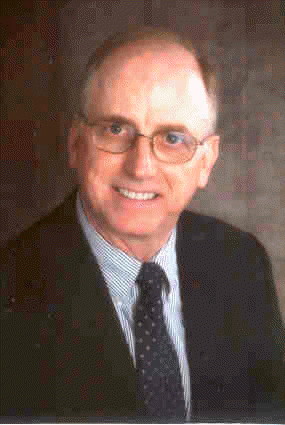
Brotherly love was a very strong value for Apostle Hill and he emphasized that any real unity among the churches in our area had to be built on genuine relationship among the pastors, and the people.  He not only talked about this, but modeled it in the way he personally interacted with other leaders and the way he led his church to interact with other groups in the County.

Robert’s wife and co-pastor, Barbara, is carrying on the leadership of Christian Love Fellowship, so let’s pray for her, their family and the church.  And ask the Lord to raise up other champions of unity for His Body here in our County.

Husbands, Wives, Parents, Children -- Ralph Martin

PicMartinRalph  

Husbands, Wives, Parents, Children by Ralph Martin Revised Third Edition, Flame Ministries, Inc. Manila, Philippines, 1997

Unity TALK IS CHEAP, the saying goes, and that seems particularly true when it comes to talk about unity. These days, every politician and popular singer apparently has to give at least an occasional plea for love and commu­nity and people getting together. If you listened to all the talk, you might well be convinced that some wonderful new age of harmony and peace is dawning for our whole soci­ety, only to be disappointed by the next day's headlines.

For behind the rhetoric, the real trend in today's society is not toward greater unity, but toward more and more individualism. That is, after all, the era that proclaims "do your own thing" that tells each individual to pursue an independent happiness without much concern for others. Some social commentators see so much preoccupation with self in our society that they call us "the new narcissists."

In the face of a society that encourages everyone to pursue a separate course, Jesus calls his people to unity, even to perfect unity. It was for Christians of today as much as of any time that he prayed: "May they all be one, as you, Father, are in me, and I in you; I pray that they may be one in us, that the world may believe that you sent me" (John 17:21).

The unity that Jesus desires for his disciples is not the insubstantial stuff of casual talk; it is as real and complete as the unity that Jesus himself shares with his Father and the Holy Spirit. It is a unity that welds separate indi­viduals together into one body, able to move together un­der the direction of one head. Jesus calls us to be in perfect unity with one another and with him. He wants us to reflect in our relationships as sisters and brothers the same unity that exists in the life of the Trinity.

The call to unity is addressed even more directly to those Christians who are married. God intends the union of husband and wife to embody in a special way the total unity that he desires for all his people. He has designed man and woman to fit together in marriage, to pass from living as two separate individuals to a life as one body, one flesh. Even our reproductive design reflects this purpose: man and woman must unite to produce new life.

The book of Genesis emphasizes this fundamental intention when it describes the creation of man and woman. The account begins with the creation of man alone: "the Lord God formed man of dust from the ground, and breathed into his nostrils the breath of life" (2:7). But Gen­esis tells us that God was not satisfied with this solitary male: "It is not good that the man should be alone" (2:18). Note the contrast here with the phrase that describes God's satisfaction when his creation is completed: "And God saw everything that he had made, and behold, it was very good" (1:31). Something about man by himself was not good; he was incomplete, unfinished.

"So the Lord God caused a deep sleep to fall upon the man, and while he slept took out one of his ribs and closed up its place with flesh, and the rib which the Lord God had taken from the man he made into a woman" (2:21-22).

Taken superficially, this passage might seem to belittle women: "What do you mean, we got made out of someone's rib!" But Arab friends have told me that in their culture a person often calls his closest friend his "rib". "Joe down the block is my good friend, my rib." The word indicates that two people are very close and share a genuine bond of unity.

In the same way, Genesis uses the image of the rib to show how closely man and woman are bound together. They are made of the same substance; they share the same life. Adam recognized this at once when he awoke and saw the woman: “This at last is "bone of my bones and flesh of my flesh" (2:23).

That fundamental unity, we are told, is the reason why "a man leaves his father and mother and cleaves to his wife, and they become one flesh" (2:24).  In the Lord's plan, a husband and wife do not just live together on friendly terms. They cleave to one another — one of the strongest possible words to apply to a human relationship — and become one flesh. While "one flesh" obviously refers to the physical union of sexual intercourse, it also means that husband and wife become a new social entity, a unit that works as one.

"The man and his wife were both naked and were ashamed" (2:25). God's original plan for the union of and woman included no shame or guilt or disorder, there was peace and freedom.

We know that this original unity, and the harmony that marked it, did not last.  When men and women disrupted their relationship with God, they also disrupted the harmony between themselves.   Genesis tells us that after the fall God said to the woman: "I will greatly, multiply your pain in childbearing; in pain you shall bring forth chil­dren, yet your desire shall be for your husband, and he shall rule over you" (Gen. 3:16). To the man he said, "Cursed is the ground because of you; in toil shall you eat of it all the days of your life; thorns and thistles it shall bring forth to you; and you shall eat the plants of the field" (3:17-18).

What a change in the relationship of husband and wife! Where once unity and peace characterized their life together, now frustration and anxiety fill it.  Even the new life that springs from their union causes the woman pain. The man, meanwhile, is caught in an endless, painful struggle to make a living.

As a sign of this change, the man and woman now have clothing. The freedom and rightness that once marked their relationship has vanished. In its place has entered a sense of shame.

Fallen humanity never fully recovered the ideal of married unity that God offered the first man and woman. Even among God's chosen people, divorce — the mark of a final breaking of unity — was a common occurrence. As long as men and women were unable to restore their origi­nal union with God, they could not live up to God's design for their life together.

That is why Jesus' teaching is so important for our understanding of Christian marriage. According to the gos­pel of Matthew, some Pharisees tried to test Jesus by asking him: "Is it lawful to divorce one's wife for any cause?" (19:3).  At the time, Jewish authorities were divided into two camps on this question: some allowed divorce only on very strict grounds, others advocated more leniency. The Pharisees wanted Jesus to come down on one side or the other of the question so that he would antagonize half the people.

But Jesus' answer went beyond what the Pharisees probably expected. "Have you not read that he who made them from the beginning made them male and female, and said, 'For this reason a man shall leave his father and mother and be joined to his wife, and the two shall become one flesh*? So they are no longer two but one flesh. What there­fore God has joined together, let not man put asunder" (19:4-6}-

"The two shall become one flesh." With these words, Jesus reaffirms in the new covenant God's original plan for marriage. He tells us that husband and wife actually do become one unit, one flesh, and that God himself stands behind their union. God wills full union between them as a fundamental part of his plan and creation. Jesus allows no room for compromise on this issue, stating even more bluntly that "whoever divorces his wife... and marries an­other, commits adultery, and he who marries a divorced woman commits adultery" (19:9).

The gospel of Matthew, although not the other gos­pels that record this incident, allows a qualification to this statement: "except for unchastity" (19:9). The interpreta­tion of that passage has caused considerable controversy, and various Christian denominations now take quite differ­ent stances on permitting divorce. But for many centuries the church took a very strict position on divorce in keeping with Scripture.

I realize the plight of the many divorced Christians today, and I do not want to imply any judgment on their individual situations. That is up to the Lord and to the responsible authorities in the churches. Today, when so many people who marry in church are only nominally Christian, one can even question whether some partners actually contract a Christian marriage.

But the complexities of the divorce question should not distract us from the clear scriptural teaching that God wants the unity of husband and wife to remain unbroken. The book of Genesis tells us that this was his original inten­tion, and the gospels reaffirm that ideal for the Christian people. Its reaffirmation was anticipated in the Old Testa­ment by the prophet Malachi, who said,"...the Lord is wit­ness between you and the wife of your youth...she is your companion, your betrothed wife. Did he not make one being, with flesh and spirit?...You must then safeguard life that is your own, and not break faith with the wife of your youth. For I hate divorce, says the Lord, the God of Israel" (Mal. 2:14-16 NAB).

Paul came later to realize the full significance of the unbroken unity of marriage, saying, "This is a great fore­shadowing; I mean that it refers to Christ and the church" (Eph. 5:32 NAB). The fidelity of husband and wife is a sign of God's unbroken covenant love for his people. That is one reason why God insists on the unity of Christian mar­riage; he wants marriage to reflect his love and his life, to set before the world an image of his own relationship to the body of Christ.

Praying Is As Important as Breathing (1) -- Dave Mangan

One of the most imPicManganDaveportant vehicles in maintaining any healthy relationship is communication. In our relationship with Jesus it is no different. Obviously then, prayer is an extremely important facet of our lives. We do this, not to keep God up to date or to keep Him on the ball, but rather, to grow in our relationship with Him and to be available to Him. This being the case, prayer deserves a lot of effort on our part. Even though we can all concede the importance of prayer, we also can easily confess great difficulty in doing it. Often these difficulties can get us to the point where we accept a very poor prayer life, or at least a lot less than what God wants for us.

His highest willingness Perhaps the first step in overcoming these difficulties is realizing that our attitude toward prayer may be wrong. Sometimes we can view God as someone who has laid an obstacle course before us, and if we successfully navigate it we get to speak with Him. But this attitude negates the very act of Jesus’ death and resurrection that gave us free access to the Father. I once heard Dr. Robert Cooke express this very well. He said, “Prayer is not overcoming God’s reluctance but laying hold of His highest willingness.”

We could start then by asking the Lord to reveal to us any poor attitudes that we may have. And then we can ask Him for the grace to let them go. We need to realize that prayer is one of the most exciting things we can do. I realize that it doesn’t often feel like that. I know that is the case for me. But that doesn’t change the truth – when we are praying we have the ear of the Master of the Universe! Any problems are on our part. We need to give Him our ear as well.

Necessary for survival It could be the case that we don’t value prayer enough. I’m sure if someone were to ask us if prayer is important we would all give the correct answer. But do our actions betray us? In reality, prayer is not just a Christian accessory, it is necessary for our survival.

Proverbs 4:23 says, “Keep your heart with all vigilance; for from it flow the springs of life.” The word “keep” here does not mean “keep” in the sense of being possessive. Rather it refers to keeping a garden, making sure that all is well and that life is coming forth. Being an active participant in our life with God is the only sure way of bringing forth real life in us, for it all comes from Him.

In short, we need to pray. If you find that your prayer life is poor, don’t give up. A poor prayer life is better than no prayer life. Just let it be a springboard to a better prayer life – step by step. Let us ask the Lord to help us and to bring us to the point that we can see that praying (however much time we spend doing it) is as important as breathing.

More -- A Practical Approach To Prayer

A Practical Approach To Prayer (2)-- Dave Mangan

PicManganDaveWhen approaching the idea of a prayer time, we easily admit that it is important. Yet sometimes the most practical details of life prevent us from actually doing it. Questions like “When and where should I do it?”, “What should I say?”, “How long should it be?” can defeat us if we allow them. To combat this I would like to offer the following practical suggestions. Have a specific time Each day pick a specific time that you plan to meet the Lord and commune with Him.. Remember that God deserves your prime time when you can give Him your full attention. Exactly what time that will be will depend on your circumstances. I would highly recommend praying in the morning before you attack the world (or it attacks you). Of course we want to be conscious of God’s presence at all times of the day, but be sure to have a special time when it’s just you and Him.

How Long? How long your prayer time should be depends on your situation. But I believe that 5 or 10 minutes regularly is better that an hour every once in a while. It’s fine to start small and let it grow into whatever amount of time that you can give regularly.

Location, location, location Try to have a specific place to meet Him each day – a quiet place where you will not be interrupted. For many of us this may not be possible on a regular basis. Don’t let that stop you, take what you can get.

How to begin Begin your prayer by acknowledging God’s presence and praise Him for it, regardless of how you feel at the moment. Remember the Lord has been eagerly awaiting this moment more than you have. He intends to enjoy it. Maybe you can also.

Forgive me ... Spend some time in repentance. Ask the Lord if there is anything between Him and you. If you feel conviction about anything confess it as sin and ask for forgiveness and healing. He is happy to set you free:

A man with leprosy came to him and begged him on his knees, “If you are willing, you can make me clean.”

Filled with compassion, Jesus reached out his hand and touched the man. “I am willing,” he said. “Be clean!” (Mark 1:40,41).

Feed on the Word Read some scripture prayerfully and allow the Lord to speak to you about it. Notice what it says. Compare your life to it. Then consider how what you can change to apply it to your life. We need to be formed by His word.

Listen Take some time to just be quiet in His presence and adore Him. Let Him speak to you.

Bring your cares to Him Bring your requests before Him. Intercede for others.

Back to praise As your time of prayer draws to a close praise Him all the more. By this time we should be able to praise Him even better than we did at the beginning.

Record His word Keep a notebook handy as you pray to record what the Lord may have said to you. You can also jot down the lessons you have learned or insights you have gained. Don’t trust your memory.

It is blessed to give Share what you are learning with someone. There is a great blessing in sharing.

One final practical suggestion I would share is don’t become a slave to practical suggestions.! The things I have shared here are good practices that can support a strong prayer life. A list like this can also be intimidating. Do what you can in your life circumstances and don’t feel bad about. Don’t evaluate it. Just do it. The approach that is described in this list is certainly not the only way to proceed or even the best way for you. I offer these suggestions as possible things that can help to jumpstart a stalled prayer life – and we all seem to stall at times.

Our life with Jesus is supposed to be dynamic and full of surprises. The problem is we have formed some bad habits that do not allow Him to act freely. Some structures, rightly applied, can help us break these habits so that Jesus might break through into our lives, and we might truly know the freedom of the children of God!

More: Problems In Prayer

Problems In Prayer (3) -- Dave Mangan

PicManganDaveAs we begin to develop a life of prayer we will have many fulfilling and exciting times with the Lord. Jesus is leading us into an adventurous relationship with the Father. But it is also the case that every Christian I know or have read about confesses to having great difficulties at times. The most common problem in prayer is dryness. It’s like a desert here Dryness is that experience in prayer when you feel you’re not getting anywhere. It feels like God is very far away and your prayer doesn’t seem to be accomplishing anything. Perhaps you used to be able to pray with great freedom for an hour and the time passed quickly. Now praying for fifteen minutes is just hard work. Your attention span is very short and you are distracted very easily. You will start out trying to pray very fervently and end up very quickly thinking about the strangest things and you’re not sure how you got there. In the midst of it all, these difficulties seem insurmountable. But if we are able to respond well to this challenge, the very problems we encounter can lead us into an even more fulfilling relationship with God.

When going through these difficult periods in prayer we are met with various temptations. The most common one for me is “I’ll do it later.” But, of course, later comes and goes away, and so does prayer. Another excuse is “I’m too busy and besides my whole life is a prayer.” That sounds very good, and indeed, our whole life should be a prayer. But if we use that as an excuse it’s like saying that my whole life is a marriage so I don’t need to have time with my spouse. Another temptation is to say, “I don’t want to be a phony. God

will know my heart isn’t in it.” To that I would say who really is the phony? Is it the person who is disciplined enough to not be a slave to his emotions and to pursue that which he knows to be the correct course? Or is it the one who lets his feelings and outside circumstances determine what he does? Remember a disciple is one who is disciplined.

Lord, teach us to pray Now that we have stated the problem what can we do about it? I would suggest that you pray and ask Jesus to teach you to pray. This has become a regular prayer of mine and I suppose it always will be. Don’t stop here though; give Him something to work with. Remember that Jesus fed 5,000 people with only a few loaves and some fish. You may not have much but give Him what you have – time. At this point it’s easy to say “I don’t have any time!” It is, therefore, essential to DECIDE that prayer is important enough to do. Then make time. Arrange your day around it.

How much time? This answer to this question will vary depending on your life situation. Keep in mind that a little done faithfully is better than a lot done very seldom. As an example, let’s take 30 minutes. You may end up taking a longer or a shorter time. When faced with 30 minutes (or any amount) to spend in prayer, it seems very long when you’re already having a difficult time praying. But look at it this way. Could you spend 5 minutes praising and thanking God? That sounds easy. Then how about 5 minutes repenting from your sins and asking the Lord’s forgiveness. Could you do that? Sure. Now we may not be the best readers in the world but I’ll bet we all could read some

scripture meditatively for 10 minutes. And with all of our problems and those we are aware that others have, we could spend 5 minutes interceding. Finally, if we would take 5 more minutes in praise and thanksgiving, we would have just spent a ½ hour in prayer. When viewed from this perspective it hardly seems long at all. You can shorten or lengthen these example times depending on what amount of time you want to start with. If we could gradually increase the time for each phase of our prayer, we could grow it to where we want it to be.

Done with drooping Some people may not like the idea of structuring prayer like this, but if something is drooping don’t be afraid to prop it up. But try to not get locked into a particular structure. When your drooping prayer life is standing tall, don’t be afraid to remove the structure and, under the guidance of the Holy Spirit, give it a new and more life- giving structure. Problems in prayer are, in a sense not really problems. Rather, they are an opportunities to grow in discipline, maturity, and prayer.

Sharing a vision of God’s Kingdom in our County -- PACT May, 2010

Pact01In May, 70 pastors and church leaders from across Washtenaw County met together for the periodic Vision Lunch sponsored by Pastors Alliance for County Transformation (PACT). Over the years these have been important occasions for folks involved in serving the Lord in their different ministries to meet face-to-face with other Kingdom servants and begin to build relationships. It is amazing how little ‘cross-fertilization’ takes place ordinarily between churches and other ministries without deliberate efforts like the Vision Lunch. Pact02In addition to fostering personal contact, the Vision Lunch is an opportunity to stretch everyone’s view regarding God’s work in our County. Different folks share about what they experience Him doing. This year we were blessed to hear from Pastor Joseph Son of the Korean Church of Ann Arbor.

Pact03In the last several years since he has come from Korea, the church has experienced rapid growth to over 400. However, as he has prayed, the Lord has shown him the strategic importance of Ann Arbor and Ypsilanti as the home to so many international people who are destined to be leaders in their home countries. Reaching them is a vital task and it will require the whole Church in our County.

Pact04A growing group of churches in Washtenaw County are praying and beginning to plan for a county-wide public school outreach. The developing vision for this was shared at the lunch, as well. There is a nation-wide ministry called Youth Alive which has an outreach entitled the ’7 project’. They work with coalitions of local churches to prepared Christians in the public schools to reach out to their peers and then do a series of ‘values based’ assemblies in the schools. There the students get solid advice about answers to 6 key issues facing youth, but if they want to hear about a 7th answer that covers them all, they are invited to come to an evening event. At this multi-media event they hear the gospel and get a chance to give their lives to Christ. This is where the churches come in, following up on those new believers and others who indicate that they are seeking.

Wouldn’t it be fantastic for the churches in Washtenaw County to work together for such an outreach to the next generation! Stay tuned for further developments!

Why Speak In Tongues -- Dr. J. Rodman Williams

WilliamsJRodmanDr. J. Rodman Williams was an influential theologian in the Protestant wing of the charismatic renewal.  This article was originally published in New Covenant in 1978, but is still relevant for us today as we celebrate Pentecost in 2010!  Let’s use the Spirit’s gift to worship our Lord!

This article is reprinted with permission from New Covenant magazine from 1978

Not too long after my first experience of speaking in tongues, a colleague told me: "I don't deny that such a phenomenon exists, but actually I see no reason for it, no value in it." In other words, why should one want to speak in tongues?

Behind this question, I am convinced, is a failure to comprehend the essential nature of speaking in tongues, which is transcendent praise of God. Speaking in tongues, or glossolalia, is an expression of praise which breaks through the usual limitations of a person's native tongue to a higher realm of praise, blessing, adoration, and thanksgiving. It goes beyond the most elevated earthly expressions, even "Hallelujahs" or "Hosannas." To put it directly: it is the praise of God in language given by the Holy Spirit.

A GIFT OF PRAISE If such transcendent praise were possible, who wouldn't want to share in it? Who wouldn't want to transcend the limits of earthly language in the high praises of God? Why speak in tongues? The answer is not far: it is the vehicle of praise par excellence for glorifying and extolling God. If there is little desire to praise God, then tongues are of little significance; but if the worship, the praise, the adoration of almighty God is the chief concern of a person's life, then tongues have unlimited value as a supernatural avenue of that transcendent praise.

The praise of God should also sound forth as fully as possible in the native speech of man. The mother tongue-whether English, French, German, or something else is so much a part of one's whole being that it is the most natural vehicle of worship. Hence there are hymns, anthems, and prayers which, whether sung litur­gically or spontaneously, declare the glory of God in the language of man. However, there comes, or may come, a moment when natural speech is left behind and one expresses the extraordinary praise of God in the language of the Spirit.

A word from personal experience may be helpful. At one time, I could see no value in the gift of tongues. Indeed, the whole matter was a bit repugnant to my sensibilities. However there came a time when all this suddenly changed.

One day, while I was saying the opening words of Psalm 103, "Bless the Lord, 0 my soul; and all that is within me, bless his holy name! Bless the Lord, 0 my soul, and forget not all his benefits," I ex­perienced a sudden desire to praise God with "all within me," to break forth in heavenly blessing. Then came the gift of a new tongue, a spiritual language—an unexpected, even shocking event.

Though new to me, tongues is not a new phenomenon. For example, there's a long history in the church of what many have called "jubilation." To jubilate is to go be­yond ordinary speech to a form of praise that even the most expressive words cannot articulate. St. Augustine wrote about jubilation in his commentary on the Psalms: "If you cannot express your joy, jubilate: jubilation expresses your joy . . .; it cannot be a silent joy." St. Thomas Aquinas, also in a commentary on the Psalms, wrote: "Jubilation is an unspeakable joy, which one cannot keep silent; yet neither can it be expressed (in words) . . . it is beyond comprehension" (quoted in Sounds of Wonder, by Eddie Ensley, pages 8 and 53).

Jubilation has often been experienced as transcendent joy or transcendent praise. Though jubilation may not be synonymous with glossolalia, since the emphasis is on wordless vocal praise rather than praise in a new language, the connection is quite close. Each is motivated by the same intense yearning: to express the in­expressible—thus to go beyond ordinary speech to the realm of transcendent praise.

OUR TONGUES: GIVEN TO GOD Speaking in tongues can be understood only against the background of a total yielding to God. This is not just a yielding to tongues, as is sometimes said, but a yielding to God in which everything, including the tongue, becomes the avenue of God's presence and power. The apostle Paul urges us to present our "bodies as a living sacrifice" (Romans 12:1). In other words, our total selves should be completely given to God.

Surely there is no part of the body that causes more havoc than the tongue. James wrote, "The tongue is an unrighteous world among our members, staining the whole body, setting on fire the cycle of nature, and set on fire by hell. . . with it we bless the Lord and Father, and with it we curse men" (James 3:6, 9). How essential the surrender of the tongue, how urgent its purification! And how marvelous that God grants a new tongue to "bless the Lord and Father"! But, to repeat, the basic matter is the surrender of everything to God.

LANGUAGE OF THE SPIRIT In yielding the total self—body, soul, and spirit—to God, the Spirit of God is able to take full control. This is what the Scriptures refer to as being "filled with the Holy Spirit." On the day of Pentecost the disciples "were all filled with the Holy Spirit and began to speak in other tongues, as the Spirit gave them utterance" (Acts 2:4). The basic matter involved God filling them with the Holy Spirit, out of which came speech in other tongues. Their speech, so full of joy that many observers thought they were "filled with new wine," took the form of transcendent praise. Truly they were filled with new wine; but it was wine of the Spirit, not of the grape.

When the Spirit of God fills a person, the deepest level of his being, namely his spirit, has been penetrated and pervaded by the Holy Spirit. The Spirit of God may have already been at work within, but this is a further visitation in which the Spirit takes inward control. This does not mean domination but freely given control, through which the Holy Spirit now functions without hindrance from the human spirit. Thus, when speech occurs, its form may not be rational but spiritual. Though spoken by man, it is a spiritual language, one which the Holy Spirit provides. The conscious mind is no longer the controlling center as in conceptual speech. Neither is the speech formed by the subconscious mind as in highly emotional ecstatic utterance. Rather, the Holy Spirit, moving upon the human spirit, brings forth utterance which is neither conceptual nor ecstatic. It is the language of the Holy Spirit spoken through the speech organs of man.

When a person is baptized in the Holy Spirit, speak­ing in tongues is a normal occurrence; normal, yet super-natural and belonging to the realm of signs and wonders. Of course there may also be rational speech in prayer, though penetrated by fresh spiritual content, since the Holy Spirit moves through all levels of the spiritual and mental. An alternation between spiritual and natural language provides mutual enrichment. But my basic point is that speaking in tongues, while miraculous, is a normal aspect of being filled with the Spirit of God.

OPPORTUNITY OR OBLIGATION? The question is sometimes asked: Must a person speak in tongues when he or she is baptized in the Spirit? The question, incidentally, usually expresses some fear or disquiet about the possibility. The answer is not that he must, but that he may! If a person is filled with the Holy Spirit, a new and wonderful thing can happen. The Holy Spirit will never force his way, but a new, even supernatural, possibility is now given. The Spirit, if allowed free access to the organs of speech, will bring forth a new and spiritual language.

Some people are so flooded with the reality of God's presence when they are baptized in the Spirit that they can scarcely contain themselves; thus speaking in tongues occurs quickly. Others, filled with the same Spirit, may, through fear, uncertainty, or self consciousness, hold things-in check, and thus do not immediately speak in tongues. However, the possibility is now present, and with the proper conditions and a willingness to venture forth, they will soon be speaking a new language of the Spirit.

This is not always easy. There is so much resistance to the whole matter of speaking in tongues—as being irrational, hyper-emotional, even a bit shameful—that it takes some courage for many to even contemplate it. Furthermore, when a person speaks in tongues he often burns his bridges behind him. That is, he or she may be labeled a "tongue-speaker," with all the negative associ­ations. Reputation, respect, or position may be for­feited. Therefore it is not easy for some to take the step. But what seems to be folly in the sight of men is wisdom in the eyes of God. When the gift of tongues becomes a normal part of Christian life, it is easier to recognize God's wisdom in presenting this gift to his children.

A RICHER LIFE In addition to the overall benefit of providing a vehicle for transcendent praise, there are several ways that speak­ing in tongues enriches the Christian life.

The gift of tongues is an audible reminder of the activity of the Holy Spirit. Whether speaking in tongues begins with only a few syllables or with a complex new language, the person who receives this gift experiences a growing sense of awe that God is present through the Holy Spirit. This new language, which the person knows he or she did not just conjure up, is a reminder of God's power and presence.

Singing in tongues adds a new dimension to cor­porate worship. The apostle Paul encourages the use of "psalms and hymns and spiritual songs" (Col. 3:16). While "psalms and hymns" doubtless refers to known and frequently used musical expressions, "spiritual songs" probably refers to songs with words and melodies spontaneously given by the Holy Spirit. The Jerusalem Bible footnote to this verse says, "These `inspired songs' could be charismatic improvisations suggested by the Spirit during liturgical assembly."

It is hard to overestimate the value of tongues in daily prayer. Some find it helpful to begin their prayer time by praying in tongues. These prayers of the Holy Spirit provide a rich background for the prayers of the mind that follow. The words of Paul are indeed true: "He who speaks in a tongue edifies himself" (1 Cor. 14:4); and the words of Jude present a continuing chal­lenge: "Beloved, build yourselves up on your most holy faith; pray in the Holy Spirit" (Jude 20).

Speaking in tongues often proves to be the door-way into a deeper experience of the other gifts of the Spirit. Since tongues are such an extraordinary avenue of prayer and praise, many persons soon find themselves moving more freely in the realm of other gifts of the Holy Spirit. It is not at all unusual to experience prophecy, healings, miracles, and other gifts of the Spirit after receiving the gift of tongues. Tongues function as the key that turns the lock of the door which leads into the whole realm of God's extraordinary workings.

The simple fact that tongues are a gift of the Holy Spirit means that the gift is not insignificant, and cer­tainly should not be despised. Since this prayer language comes from the Holy Spirit, it is a pure and holy lan­guage, regardless of the speaker's imperfection. It is, in my estimation, the noblest language this side of heaven.

Interdenominational Blessing -- Martha Balmer

BalmerMarthaIII am absolutely confident that the Lord is calling Christians of all denominations to bless one another across the denominational lines that separate them. I believe that this mandate has a glorious purpose beyond anything we have imagined possible for the Church as we know it. Doctrinal arguments, cultural biases and historical resentments all have a very real hold on the Church’s throat, but in our lifetime we have seen an outpouring of grace for unity across denominational lines that as far as I can tell is unprecedented. I believe that the exhortation to mutual blessing is not only authentically prophetic, but that it is being delivered on a tidal wave of this timely grace. If we obey and bless one another, we will see a greater harvest than we can plant—a restoration of the Body of Christ that our imaginations are too limited to picture. If we hope to be obedient to this word, we need to make a decision to turn our current church-view over to God for a possible overhaul.

Implications of being the Body The Apostle Paul loved to liken the Church to a human body. In I Corinthians 12, Ephesians 4, and Romans 12, he used this image to illustrate both our variety and our unity because the metaphor worked on so many levels. We are a single body, made up of many distinct organs that perform essential and interdependent functions for the health of the whole. None of us can survive alone, and each of us is necessary to the others.

It is a fairly simple thing, and quite correct, to apply these passages to the local church body, since the gifts Paul lists are all ministries that may belong to individuals or to small groups of believers in a single congregation. It is also easy to apply them to an entire denomination, with its governing body, delegated ministries, and missionary efforts. But in order to bless one another interdenominationally, we need to apply these passages interdenominationally. I don’t believe that Paul intended to exclude their application to the worldwide Church in all its diversity.

Such an application is not far-fetched, because Paul himself uses the body illustration in a greater sense. We are not just any old body. We are the Body of Christ— male, female, Jew and Greek, barbarian, Scythian, slave and free. Since our Lord’s ascension, we together are His incarnation to the world. A lot rests on our health and well being. Christ himself prayed for our unity (John 17), and Paul’s pastoral letters are full of exhortations and instruction specifically aimed at encouraging or restoring the unity of the body.

Unity under attack So much rests on our unity, in fact, that our Enemy has been waging an intense battle against it since the Church’s earliest days. Satan has attempted to tear the Bride limb from limb and has had great success, as any perusal of Church history will prove. The first century Christians were repeatedly harassed by division (see for instance I Corinthians 1:10-12, Acts 15, Philippians 4:2-3, and I Corinthians 11:17-22). Doctrinal arguments rose over the ensuing centuries, along with geographical and political divisions that finally did split the church into East and West. Infighting and corruption within the western church even resulted in the short-lived embarrassment of having three simultaneous popes in the early 15th century. Eventually, with the Reformation—like a man who allowed himself to commit a sin for the first time and then never again enjoyed his former level of self-control—the Church began to splinter into its current, multi-denominational form.

But for those who love God and are called according to his purpose, all things work together for good, even things our enemy meant for our destruction.

Looking back at our history, it is possible to see that many times our conflicts and alienation chastised us, eventually producing the very reforms that we had so vehemently resisted. (Catholic clergy no longer sell indulgences, and Methodist churches no longer charge a fee for the use of a pew, for instance.) And though sometimes we seem to have become so different that we can no longer see any family resemblance, isn’t it the gaps between us that have brought our varied gifts into sharper focus and often made us painfully—and fruitfully—aware of our insufficiency? Could it be irrelevant, for instance, that during the last century so many liturgically conservative denominations had an influx of Pentecostal experience?

Together reflecting His glory We are not meant to function on our own. At the very least, none of us is attractive to the whole pool of the unconverted. Some of us excel in scholarship, others in evangelism, others in prophecy and still others in ministry to the poor. Some of us are liturgical, some spontaneous, some mystical, some pragmatic. Some of us lean into tradition and others tend toward innovation. Some of us are pacifists. Some of us are militant. Some of us love simplicity and others delight in lavish expressions of praise.

I guarantee that if we are meant to reflect the complete image of Christ, none of us can possibly imagine the richness of variety we will have to contain. God is greater than we think, and more than any of us can represent alone. Our personal experience, tradition, culture or taste cannot possibly encompass his attributes, and yet he has called us to reflect his glory.

I suspect we can pretty much take for granted that none of us will be comfortable with all of it. I doubt that any of us is currently capable of complete fearlessness at the prospect of genuine unity. Our opinions are strong and have centuries of history behind them. In my experience, for example, the average Protestant can’t tolerate the idea (I’m putting this mildly) that the Body of Christ is ultimately meant to look Roman Catholic. Likewise, no devout Catholic can envision the solution otherwise. Pentecostals may be unable to imagine that our restoration could possibly include “dead ritual,” and Lutherans might shudder at the possibility of unfettered “disorder.”

Gaining through giving I believe that the essential function of the acts of blessing God has prepared for us is to restore the mutual benefit of each part to the whole. The prospect before us is not one of loss, as though we were being asked to give up the very distinction that we love about ourselves. It is rather a prospect of riches unimaginable, as we receive from one another out of our storehouses and find ourselves able to do all things in the One who strengthens us.

I believe that as we contemplate the restoration that mutual blessing will bring, our greatest temptation will be fear. But if we entrust the results to God, we know we are committing ourselves to someone who is absolutely trustworthy—and whose ultimate plan for us is not only utterly good, but also simply right. What greater aspiration could we have as a people than to reflect His image purely at last? As the Apostle John wrote, “Dear friends… what we will be has not yet been made known. But we know that when it is made known, we shall be like Him.” (I John 3:2)

Why pay the price for Unity? -- Phil Tiews

VisionEcumenicalGraphicA Broken BrideThe wedding march swells as all eyes turn toward the back of the church in anticipation of the Bride’s grand entrance.  The Groom’s heart swells, too, as He eagerly awaits His love’s coming forth to be joined together forever.  There is a scuffling sound and down the aisle scurry two feet beautifully adorned in white satin shoes.  They are followed by a pair of legs, but before they can make it to the front, they are overtaken by arms, each with hands waving for attention.  The torso comes next, hopping and rolling forward awkwardly, but forcing a place in the middle of the appendages due to its greater size.  Lastly the head processes, chin held high in a sense of dignity and beauty, at least as high as it can be given the absence of a neck which refused to take a subordinate position and is up first, glad to be ahead for once.  As the various members of the body of the Bride jockey for position closest to the Groom, the look of pain and grief on His face, still mingled with undying love, can only be imagined.

The Bible tells us that all God’s work in history is moving toward the great wedding feast of the Lamb when Jesus will have His heart’s desire, to be married eternally to the Bride the Father promised and He purchased by His own blood.  If the wedding were to take place today, I am afraid that it would be more like the one pictured above than the glorious feast of Revelations.  Jesus’ Beloved is divided along theological, racial, ethnic, and cultural lines.  She is further broken by disputes, prejudices, and damaged relationships.  What cause we have for mourning and humiliation over her state!

In our shame and consternation, though, there is great reason for rejoicing.  God promises that

…Christ loved the church and gave himself up for her to make her holy, cleansing her by the washing with water through the word, and to present her to himself as a radiant church, without stain or wrinkle or any other blemish, but holy and blameless.  Eph 5:25-27

Jesus will complete the work He began on the cross, removing stain, wrinkle, blemish – to say nothing of brokenness and division – so that on the great wedding day, the Bride will be radiant.  We live in trust in His power and love to bring this transformation about.  And in the meantime we cooperate with every movement of the Spirit in our lives to prepare us for that day. 

This is the first reason that we are an ecumenical community.  We are looking for the day when the Bride will reflect in her wholeness, devotion and radiance the love which flows from Jesus to us.  Only God can resolve the divisions and heal the brokenness, but we can cooperate with the grace He has extended to us to walk out in a limited way that Bridal radiance by loving and serving each other across lines of church, tradition, culture and more.  Christian unity is not an exercise in tolerance; it is the heart response of the Bride as she is being prepared to be presented to her Groom.

A Team Divided on Itself There is a second motivation for our investment in unity.  Imagine an all-star football team, something like the NFL Pro-Bowl.  Representatives from many teams have assembled, a few from the Patriots, several from the Eagles, only one from some teams, but each gifted and accomplished in their own way.  The whistle blows and the ball is kicked off, the game begins.  But there is something wrong here.  The Colt quarterback will only throw to the tight end because he is also a Colt, ignoring all the other receivers.  Meanwhile the right tackle decides he won’t block for the running back because his team was beaten badly by the back’s team earlier in the year.  So it goes, players working with those from their own teams or a few others who they like for one reason or another, but without any overall unity or cohesion.  You know what the result will be, a shellacking of the All-Pros by the All-Foes.

We are in a contest far more serious than any Pro-Bowl – a war for the souls of men and the revelation of the kingdom of God on the earth.  Our spiritual enemies take advantage of the gaps in our lines and those who we hope to reach pull back because the message of the Gospel is marred by the rancor of the messengers toward one another.  Jesus said

 I pray also for those who will believe in me through their message, that all of them may be one, Father, just as you are in me and I am in you. May they also be in us so that the world may believe that you have sent me? John 17:20-21

The world looks at us to see what they can learn about Jesus.  When they see a unity rooted in the love for one another such as the Father and Son have for each other, Jesus says it will be a sign testifying to Him. 

A Family Discovered We find ourselves in the back of a van on a long trip.  Around us are all these other kids who look different and act different than we do, and who frankly are beginning to get on each other’s nerves.  We cry out to the Driver, ‘Dad, these kids are bothering us!’, only to hear, to our shock, all the other kids crying the same thing!  Something is wrong here.  Where did Dad pick up all these others and why are they on the family trip with us and who do they think they are addressing our Father as ‘Dad’.  Just then Dad turns around and shouts “Don’t make me stop this car and come back there!!!” – no just kidding!  Dad actually turns around and addressing all of the kids at once says (adjusting the pronouns just a bit):

19You love because I first loved you. 20Those who say, “I love God,” and hate their brothers or sisters, are liars; for those who do not love a brother or sister whom they have seen, cannot love God whom they have not seen. 21The commandment you have from Me is this: those who love God must love their brothers and sisters also. 1 John 4:19-21

A third reason that we are an ecumenical community is that those who have known the love of God and love Him in response, also must love what He loves.  And it turns out that what He loves are all those other folks who are alive in His Son, Jesus, but are not like us!  We have discovered that in Jesus we are all brothers and sisters, children in the same family and we can’t do a thing about it.  Now, like it or not, we need to love one another!  But actually, the more we are conformed to the image of Jesus, the more we like it!  We might not agree, but we don’t need to agree in order to love.  If we did, marriage would never work!  We just need to lay our lives down for one another as Jesus did for us.

A Costly Calling It is costly to be an ecumenical community.  It is simpler and more efficient to work with those who agree with us theologically, organizationally, culturally.  And God loves and blesses the different expressions of his Church on the earth who share these traits in common.  But he has blessed and honored us with a costly call – to try to express in our limited way that unity which we shall all someday have in fullness at the wedding feast of the Lamb.  Living this call is inconvenient, it makes extra demands on our schedules, at times we hurt or aggravate one another – but it is worth it!  We get to experience imperfectly, in humility, but prophetically the oneness for which Jesus prayed, hopefully as an encouragement and a testimony to the whole Body of Christ. 

How Charismatic do you want to be? -- Aimee Bacik

I came that they might have life and have it more abundantly.”          John 10:10

  PicAimeeBacikOne of the five main charisms that define The Word of God is that of being charismatic – open to the work of the Holy Spirit in our lives, and actively seeking all that the Spirit has for us.  Jesus promised that he came that we might have life, and have it to the full.  This means that we cannot keep the “charismatic” part of our life with him confined to our Sunday prayer meetings or other times that involve charismatic worship. 

We are called to live lives that are characterized by the power of the Holy Spirit working in and through us.  As Paul says in his first letter to the Corinthians, “For the kingdom of God is not a matter of talk but of power.”  (I Corinthians 4:20)  How do we live the life of the Spirit on a daily basis?  How do we live a life of power?

Pray for God’s direction - then listen!  I have always tried to pray about what God wants me to do and listen for his voice leading me.  He has spoken to me clearly in many ways throughout my life.  It was through his guidance that I was able to make major decisions in my life, such as deciding where to go to college, where to go to law school, and whether to join the community. 

While I seldom forget to pray about the big choices that I make in my life, I find that it is sometimes easy to forget that God wants to be involved in the small choices, as well.  The evangelist Benny Hinn wrote that he began each day by saying, “Good morning, Holy Spirit!”  This was his way of inviting the Holy Spirit to guide him and lead him throughout the day. 

While not all of us might feel led to say those exact words each morning, we should begin each day by giving it over to the Lord and inviting him to be in control of what we do and say.  Not only do we need to begin each day this way, but we should also continually ask the Holy Spirit for guidance as we go about caring for our families, interacting with our co-workers, doing our daily work, or even simply being with our friends or family. 

We have heard many prophecies over the past few months about the divine appointments that the Lord has for us.  However, many times we are too busy and too distracted by our daily lives to notice ways in which the Lord might be presenting us with divine appointments.  Just by taking a few minutes every hour or so to come before the Lord and ask for the wisdom and guidance of the Holy Spirit, we can become more sensitive to his leading, and allow him to work through us.  I think that we will be amazed by the ways the Lord wants to work through us, even in the small, day-to- day details of our lives.

Expect God’s graceIf you then, who are wicked, know how to give good gifts to your children, how much more will the Father in heaven give the Holy Spirit to those who ask him?” (Luke 11:13)  This was probably one of the first scripture verses that I can remember memorizing as a child.  It is one of the verses that is included in the Life and the Spirit Seminars that The Word of God has given over the years to many thousands of people. 

How many of us really believe this passage?  I do not mean just know that it is true, I mean believe it with all your heart, and be willing to stake your life on it?  Do we really believe that God is just waiting to pour his Holy Spirit down on us?  Do we live each day expecting the power of the Spirit to be manifest in our lives?  I know that I do not always find it easy to believe this.  Yet, Paul tells us that the Lord is “able to accomplish far more than all we ask or imagine by the power at work within us.”  (Ephesians 3:20) 

I believe that the Lord wants to do powerful things in and through us.  If we come before him in faith, asking for his Holy Spirit, he will hear and answer our prayer.  Jesus wants to give us the Holy Spirit more than we want to receive him.  If we come before him with open hearts, we will be filled.  Paul tells us to “strive eagerly for the greatest spiritual gifts.”  (I Corinthians 12:31)  He would not have urged us to strive after spiritual gifts if the Lord did not want us to have more gifts.  I believe that we have only just begun to see the gifts that the Lord has for us.  There is much more that he wants to give us.

Broad view of  “gifts of the Holy Spirit”  The Lord does not just have one gift for us, he has many gifts for us.  Often, however, we do not have a broad enough idea of the gifts that the Lord wants to give us.  There are many places in the Bible where gifts of the Spirit are listed.  For example, Isaiah 11:2-3 lists wisdom, understanding, counsel, strength, knowledge, and fear of the Lord.  In Romans 12:6-8 Paul lists prophecy, ministering, teaching, exhortation, generosity and acts of mercy.   In 1 Corinthians 12:28-30, Paul also lists apostles, mighty deeds, administration, healing, assistance, tongues and interpreting tongues. 

Do we limit God by our definitions of what are gifts of the Spirit?   When I was in college, I spent a great deal of time doing administrative work for University Christian Outreach.   Although I was good at the work, I did not especially like it.  Once I realized that it was a gift of the Spirit, my attitude towards doing the work totally changed.  I was able to view my work in an entirely different light.  Rather than being something that I was just good at doing, I began to view the administrative work as an opportunity to exercise a gift from God. 

I believe that the Lord has given us many of the gifts listed above, as well as many other gifts that I have not listed.  If we ask God to open up our eyes to the gifts that he has already given us, and to the many gifts he wants to give us, I believe that we will see many amazing ways in which the Lord wants to use us.

Share the life of the Spirit. God did not give us gifts of the Holy Spirit so that we could hold onto them for ourselves.  He gave us the gifts so that we could build up the body of Christ.   As Paul says, “he gave some as apostles, others as prophets, others as evangelists, others as pastors and teachers, to equip the holy ones for the work of ministry, for building up the body of Christ….”  (Ephesians 4:11-12)  Not only are we called to share our gifts with one another, but we are called to reach out to those around us and share the good news. 

We have been given the amazing gift of abundant life in the Spirit.  We have not been given this gift because we are worthy, but we have been given this gift because we are amazingly loved by God.  This is a truth that the world is dying to know.  God is calling us to reach out and tell those around us of the good news of his love, and of the gift of his Holy Spirit.  Soon, we will have an opportunity to act on this call.  In May, The Word of God will be sponsoring and running a Life in the Spirit Seminar.  Is there someone who the Lord wants you to invite to come?  Is this something that the Lord would like you to attend so that you can be refreshed in the Spirit?

Intimacy and Mission.  In the last few months we have heard many prophesies about intimacy with God, and reaching out to evangelize those around us.  Both of these things are impossible to do without an outpouring of the Holy Spirit in our hearts and minds.  I think the question that the Lord is asking us right now is, “How foolish are you willing to be?”  Are we willing to look foolish in the eyes of the world in order to show others what it means to live life abundantly?  Are we willing to allow the power of the Holy Spirit to work in and through us in mighty ways, in ways that we have never imagined?  If we are, I believe that we will see the power of the Lord in ways that we have never seen before.

The Word of God Launches New Website

PicPhilTiewsFinally catching up some with the 21st century, The Word of God is launching a website so revised it is really new!  Our vision is to be more than a barebones source of information about the community.  We hope to provide resources people, both community members and others, will find helpful and encouraging as they seek to follow the Lord.  Check out the library for articles on a variety of subjects and testimonies of God’s work in people’s lives. This is meant to be a collaborative effort – a community website in fact and not just name!  Several of the articles have an option for adding a comment to dialog about the topic and share what God is teaching us.  If you would like to add an article, we are eager to hear from you.  You can send it to Phil Tiews at Phil@thewordofGodcommunity.org .  The Lord has poured so much into our lives over the years in The Word of God, we hope the website will provide a venue for sharing some of that with other brothers and sisters.  We also welcome suggestions for how to improve the site.

The new site was possible due to the massive effort of Matt Stauffer and Steve Lucchetti.  Lots of thanks to both these brothers.  If you would like to join the team to continue developing and maintaining the website, please contact us!

Evidence For Evangelism -- Bob Magill

How a lawyer assembles the evidence for the defense of the Gospel


by Bob Magill

The year 2000, a millennial year and a jubilee year, is a good year to tell others about the person who is the reason for the dating system which we use. One tool that we can use in evangelism is the historical evidence for our faith.

Like a trial, history attempts to discover and explain events that occurred in the past. It uses the evidence of witnesses and things in order to arrive at some conclusion both about what happened and the significance of what happened. The "rules of evidence" for both disciplines are essentially the same and are based on common sense—the way human minds work.

Now what I'm talking about here is evidence that the Gospels are good history, not that they are inspired books or inerrant. By simply demonstrating that the Gospels are reliable history, we can more easily introduce someone to Jesus. They can then discover for themselves why the church, in creating the canon, came to believe that the books were inspired as well.

Much has been made in the secular press of The Jesus Seminar, a group of liberal Bible Scholars who have tried to cast doubt on the historical reliability of the Gospels. However, they are much longer on opinion than on facts. We can give facts.

Lets look at the things that we could show to a jury in the courts of history. The first phase of a trial is to get evidence admitted. What is our evidence?

1. Manuscript Evidence Very old physical manuscripts of the New Testament, in whole or in part, have been preserved. Look at their great number, the relatively short gap in time between the date of the creation of the original writing and the events recorded, and the harmony between the various manuscript copies. Now compare those factors with those of other ancient histories. It is easy to see that the manuscript support for the New Testament as a whole is better than for any other ancient history. See the chart (Exhibit 1). Ancient history doesn't get any better than this.

2. Dates and authorship If the gap in time between Jesus and the time the Gospels were written can be claimed to be large, some scholars use the claimed gap as an opportunity to insert their own opinions as to what really happened, dismissing the Gospel  


WORK


WHEN WRITEN


EARLIEST COPY


TIME LAPSE


#OF COPIES


Herodotus


488-428 B.C.


A.D. 900


1,300yrs


8


Thucydides


c 460-400 B.C


C. A.D. 900


1,300 yrs


8


Tacitus


A.D. 100


A.D.1100


1,000 yrs


20


Caesar's Gallic War


58-50 B.C.


A.D.900


950 yrs


9-10


New Testament


A.D. 40-100


A.D.130 full manu­scripts A.D. 359


30-310 yrs


5000+ Greek, 10,000 Latin, 9300 others


Exhibit 1. When compared to other ancient texts, there are far more copies of the New Testament written far closer to the events portrayed in them, than any other ancient docu­ment. Based on this, we have more reason to trust in the reliability of the new Testament than Julius Caesar's Gallic War!

accounts as legends. Thus, over a hundred years ago, The German Tubingen school claimed that the Matthew, Mark and Luke's Gospels were first written after 130 AD and John not until the late second century.

Then in 1934, the noted papyrologist C.H. Roberts exam­ined a neglected papyrus fragment of the Gospel of John, which had been recovered from Egypt, and dated it to between 100-150 AD. (Exhibit 2) Since this was a fragment of a copy found in Egypt, far from Ephesus, the original was undoubtedly written earlier. The range of dates now given by mainline scholars for the writing of the Gospels runs from 50 AD (earliest) to 100 AD (latest). See Josh McDowell, The New Evidence That Demands A Verdict. 1999, p. 52.

 MagillExh2

Exhibit 2. How old are the Gospels? Some skeptical scholars used to date them 130 AD or later. Then in 1934 this fragment of a copy of the Gospel of John was discovered in Egypt, miles from Ephesus where it was written. It was dated between 100-150 AD, pushing the authorship of the original back to 50-100 AD, well within the lifetime of John, the purported author.

Internal evidence alone suggests, at least for Luke, a date near 60 AD since his Gospel precedes his Acts which ends without telling what happens to Paul, who died c. 62-67AD.   This date range is sufficient to allow for the Gospels to have been written by, or with testimony from, eyewitnesses. But there is even more evidence pertaining to authorship. Early church documents exist, some only in fragments recorded later, whose authors claim personal knowledge of the authorship. For example, Papias (c. 125 AD) records a statement of John that "Mark having been the interpreter of Peter, wrote down accurately all that he mentioned, whether sayings or doings of Christ...' Irenaeus (c. 180), who was a disciple ofPolycarp who was a disciple of John, also attests that the four Gospels were written by the persons whose names they bear: Matthew ("when Peter and Paul were preaching the gospel In Rome"), Mark, Luke, and John the "disciple of the Lord, who also leaned on His breast, himself produced his Gospel, while he was living at Ephesus in Asia." (as quoted in Lee Strobel, The Case for Christ. 1996.p.23-24).

3. Corroboration documents archaeology

A. Documents: There is corroboration of the existence, death, resurrection and sayings of Jesus from another witness: Paul. "The authorship and early date for eight of his letters (including Gal. and 1 & II Cor.) is undoubted." (Columbia Encyclopedia. 5th ed., 1993) Paul states that he was an eyewitness to the risen Lord and that he had been in personal contact with eyewitnesses to Christ's ministry:

Peter, James, and John (Gal.l and 1 Cor. 15: letters written 49-56 AD).

Non-Christian sources also corroborate that some events described in the Gospels occurred and were noted by contemporary historians. For example, the Roman historian Tacitus (115 AD; Annals 15.44). describes the leader of the Christians whom Nero persecuted: "Christus, from whom the name had its origin, suffered the extreme penalty during the reign of Tiberius at the hands of one of our procurators, Pontius Pilatus"

Josephus, the Jewish historian, wrote 3 passages in his book The Antiquities of the Jews (c 93 AD) which confirm some of the events recorded in the Gospels: the murder by Herod of John the Baptist, the killing of James after the death of Festus, and a lengthy passage about Jesus. Some claim that this passage, in whole or part, is an addition to Josephus by Christians; but it appears in all the existing manuscripts. The most objective version is a 4th century Arabic text saying "they reported that he had appeared to them three days after his crucifixion and that he was alive: accordingly, he was perhaps the messiah concerning whom the prophets have recounted wonders." (McDowell, p. 57)

Exhibit 3

B. Archaeology: Numerous archaeological finds have been made confirming details found in the Gospels, while none have been discovered which contradict. For example, the pool of Bethesda (John 5:2) has been excavated (see F.F.ruce, "The New Testament Documents: Are They Reliable?, p, 94). And in 1961, an Italian team turned over a stone being used as a step in Caesarea Maritima and discov­ered the only known inscription referring to Pontius Pilate.    Exhibit 3. Some used (to doubt the account of the crucifixion because no historical record of Pontus Pilate had been found. In 1961 Italian archeologists discov­ered in Caesarea Maritima, a fragmentary inscription carrying the name of Pontius Pilate. Caesarea Maritima was the usual residence of the Roman authori­ties in Judea. In full, the inscrip­tion states that Pilate, the Procu­rator of Judea from 26-36 AD, dedicated a temple in honor of Tiberius.

4. The Lack of Factual Rebuttal Evidence

While there are "expert witnesses" with opinions against the Gospels as history, they have no "fact witnesses" to support them. There is not—as far as I know—testimony from any 1st or 2nd century witness who says "I know personally—or I have been told by a person with personal knowledge—that a) the events in the Gospels did not happen b) Jesus never existed c) the Gospels were not written until the second century d) the Gospels were not written by Matthew, Mark, Luke, and John or e) any combination of the above." Thus, the only fact witnesses in the matter support the historical quality of the Gospels.

Now, whether or not the Gospels are accurate and credible and reliable on all points or whether miracles can occur are other matters. That is for the second trial phase — argu­ments over the credibility and interpretation of the evi­dence, a phase we must discuss some other time. All that I have attempted here is to get the evidence admitted into court, that is, to get someone to read the Gospels as history.

But as a foretaste of such arguments, I would respond to someone who cites The Jesus Seminar that "The Jesus Seminar represents an extremely small number of radical-fringe scholars who are on the far, far left wing of New Testament thinking. It does not represent mainstream scholarship. ..What they have in mind is a totally new form of Christianity." (Gregory A. Boyd, quoted by Strobel, p. 114-115). What we have in mind is the truth" of the things which have been accomplished among us, just as they were delivered to us by those who from the beginning were eyewitnesses and ministers of the word." Luke 1:4 & 1.

The Simple Truth -- Dave Mangan

PicManganDaveHave you ever wondered why life is so complicated and everything is so difficult?  What if it's not?  Have you ever had the experience of taking a lot of time and effort to accomplish some task only to find out that it could have been done in one third of the time with only half the effort?  I sure have.  So what's the missing ingredient?  I think the missing ingredient is truth.  Simply put, when we see things for what they really are we can respond in the wisest manner.  It is my contention that the Christian life is simple.  Don't get me wrong, I don't mean that it is easy.  By simple I mean that it is not complicated -- it doesn't have many moving parts.  In 2 Corinthians 11:3 Paul urges us not to be "led astray from a sincere and pure devotion to Christ."  Another translation says don't be robbed of the simplicity that is in Christ.

Another way to put this is that you know a whole lot more than you think you do.  We who have been baptized into Christ have received a tremendous amount of grace and knowledge.  Think about it and I'll bet you that in about 90% of your situations you have no trouble distinguishing what is the right thing to do.  The teachings of scripture and the Church are clear.  Also consider this.  Our major "problems" usually don't come from that 10% of our situations that may be a bit more difficult to figure out.  Our problems more commonly come from those situations where we know what we ought to do but we don't want to do it.

So how do we handle this problem?  I think a prescription of realizing some simple truth and a double dose of God's grace is the solution.  I know when I am fighting one of those battles when I want to do it my way rather than God's way, the basic problem is that I don't really believe that any one will take care of me if I don't take care of myself -- not even God. 

But what is the truth?  The truth is that God loves me and he showed it when Jesus died for me on the cross.  In the Gospel of John we read: "For God so loved the world that he gave his only Son..."  This was a tremendous act of love.  How much proof do I need!  All that he does is love.  When he deals with me in any fashion, whether I understand it or not, he is acting out of love for me.

One of the ways I like to share this truth with others is to say that God loves you whether you like it or not.  God loves you and there is nothing you can do about it.  It doesn't begin with you.  It isn't true merely because you believe it and you can't make it go away by not believing it.  God loves you because that's the way he is.  So there!

So what do we do if we have cut ourselves off from that wonderful love?  This is where the double dose of grace comes in.  God is absolutely delighted to forgive us and show us mercy if we turn to him.  Consider a couple of thoughts from the scriptures. 

In Micah 7:18 we read:  "Who is a God like you, who pardons sin and forgives the transgression of the remnant of his inheritance? You do not stay angry forever but delight to show mercy."  He doesn't forgive us grudgingly.  He enjoys doing it.

In Mark 3:13 we are told: "Jesus went up on a mountainside and called to him those he wanted, and they came to him.  As I read this one day my eyes kept landing one the word "wanted."  I began to realize that he didn't just call me because he had to or because it was his job.  He actually wanted to do it.  He really likes me.  Growing in these simple truths has changed my life.

In summary let me put it this way.  God loves us and his love for us is complete and unconditional.  We have turned away from that love and have gotten ourselves into a peck of trouble in the process.  And if that's not bad enough, we might even do it again.  But thanks be to God he has provided a solution to our dilemma -- his wonderful, forgiving grace.

I pray that as you have read this you have experienced more than my inadequate words.  I pray that the Holy Spirit has brought these simple, basic truths to life in your heart.  For that you need his grace.  I can't give that to you; you'll have to ask Jesus for it.  After all, you're better off dealing with him than me anyway.

Missionary -- Vision

MissionaryVision01‘Therefore go and make disciples of all nations…’ (Matt 28:19) ‘…you will be my witnesses … to the ends of the earth’ (Acts 1:8)

Jesus very clearly sent his disciples out to spread the gospel and establish his church in all the earth.  And they responded!  Within decades the Good News had spread to the known world.

Does he intend for all of us, his current day disciples, to go to the foreign mission field, or join some mission here in America?  We believe the answer is ‘yes’ … and ‘no’!

Our understanding of the Christian life is that we are those who ‘… are not our own; we were bought at a price.’ (1 Cor 6:20)  Our lives belong to Jesus and it is our honor to have him direct them where he will.  For some of us that may mean being uprooted and sent out to a new place to serve him as a ‘missionary’.

However, the call to a missionary lifestyle is not confined to those serving in ‘missions’.  All of us are called to live not for ourselves, but for Jesus.  He has prepared us and deployed us through every sphere of society to be ambassadors of his Kingdom – in our homes, offices, schools, businesses, neighborhoods … everywhere.  Christianity isn’t divided into the active and the observers.  All of us have the great privilege of being partners with Jesus in his rescue mission to the world, seeing people redeemed and the structures of society transformed.

As Paul asks in 2 Cor 2:16, ‘who is equal to such a task?’  We know that we cannot live such a radical vision of Christian life and service by our own strength.  By his Spirit, God draws our hearts into mission and empowers us to serve. 

So, if his call is to ‘go’, then go.  But even if his call is to ‘stay’, we are still his missionaries in all the circumstances of our lives, bringing the aroma of Christ wherever we go.

Be Filled With The Spirit

Jesus made a promise to his followers, ‘you will receive power when the Holy Spirit comes on you; and you will be my witnesses in Jerusalem, and in all Judea and Samaria, and to the ends of the earth.’ Acts 1:8  And this is exactly what happened!  On the Jewish feast of Pentecost the Holy Spirit filled Jesus’ followers and everything changed.  Their faith awoke.  They shared about Jesus boldly.  They were used to heal people.  They experienced guidance. And more… What happened back then wasn’t a one-time event to kick-start Christianity.  The Bible describes it as ‘the gift of the Father’, the gift of his own Spirit to dwell in those who are united to him through faith in Jesus.  We aren’t meant simply to believe the right things about God, but to live in intimate unity with him because he dwells within us!  Exactly HOW this all works is a great mystery, but the good news is that it DOES work!

Just some of the things the Bible tells us the Holy Spirit will do in us:

  • Conform us to the image of Jesus (II Cor 3:18)
  • Change our character – the fruit of the Spirit (Gal 5:22-25)
  • Give us gifts to serve others and share the Gospel (I Cor 12, Rom12)
  • Guide us (John 12:26)
  • Empower us to worship (John 4:23)
  • Unite us with other Christians (Eph 4:2-5)

Is the infilling of the Holy Spirit for you?  Yes, all those who are united to Jesus are given his Spirit.  The Bible urges us to open fully to the Father’s gift, to ‘be filled’ with the Spirit.

How can you be filled more completely with the Spirit?  It is pretty simple – ask.  Jesus said, ‘… how much more will your Father in heaven give the Holy Spirit to those Luke 11:13)

  • Ask God in faith to fill you with his Spirit
  • Begin to respond to new things you experience which seem like the Spirit’s fresh action
  • Seek other Christians who are trying to ‘walk in the Spirit’ for mutual support

__________________________

To learn more view our calendar and join us at an upcoming Prayer Meeting or Contact us for other opportunities

Community Life Nights are Back this Summer!

We had so much fun together last summer that we are bringing back the Community Life Nights! 

CommunityLifeNight01

Mark your calendars now for the following dates: Saturday, July 17. 5:30—8:00 pm       @ Westminster Presbyterian Church, 1500 Scio Church, AA Saturday, July 31, 4—7 pm       @ Dawn Farm (see below for details)


 CommunityLifeNight02 Plans are just getting formed, but here are some of the things you can expect:      Great ‘organized pot-luck’ dinner      Activities for children of all ages and adults Workshops on things like:      Crafts                 Worship Signing      All your Technology questions answered      Irish Dancing        C. S. Lewis      Digital photography And more

CommunityLifeNight03If you have a recommendation for an activity or you would like to help with one of these, please let me know!

New this year – All-Community Service Night On July 31 we will be going to Dawn Farm and doing a variety of tasks to help their tremendous ministry.  There will be something for everyone from farming to cleaning to office work, whatever is needed.  And then we will close with a dinner at which some of the residents may join us.  Sounds like a great day!


More details will be coming soon, but make sure to set the dates aside now.  Hope to see you this summer!

The Word of God Calendar

Healing of Vision -- Steve Thomashefski

Sometime during the months of September and October of 2003, I noticed that the vision in my right eye seemed to be progressively getting worse. I saw Dr. Gary Moss on the 14th of October to have my eye checked. Having seen him in January of 2003, he asked why I was back so soon and I gave him the explanation. He told me in January the vision in my right eye was 20/60 and the vision in my left eye was 20/70.

After the eye exam he said something like this: “In 20 + years of practicing optometry I have never seen anything like this. Your right eye is still 20/60-70 but your left eye is 20/25! That’s like 5 lines on the chart!

He proceeded, at no charge to me, to look at and test the 3 factors that determine vision:

     1.   the depth of the eyeball;      2.   the shape of the eyeball;      3.   the condition of the lens.

The depth and shape of the eyeball (which he measured) were the same as they were for as long as I’ve been his patient. He did not have the equipment to measure the lens but after a ‘visual inspection’ he said he could see no difference from previous exams. As a scientist, he had no explanation for how my vision improved so radically!

Glory to God who “gives sight to the blind”! In part I feel like the Lord is doing in the “natural” while at the same time He is also sharpening and clarifying my vision of the “supernatural” 

Thank You Lord Jesus!

Healing Of My Back -- Betty Brice

BettyBriceWe had gone through the Life in the Spirit Seminar and this was the evening we were to be prayed with to receive the Holy Spirit and whatever gifts the Spirit had for us. When the time came, my back hurt so much that I couldn't concentrate on what was going on.  I had injured it many years before and, because it was the vertebrae where the nerves went through to my arms, etc., it never healed properly.  I eventually had had to have carpal tunnel surgery in both wrists, but even then the symptoms weren't completely alleviated. It would be okay for a while, but with use, the pain would return and continued to get worse and worse until I had to have a series of traction treatments. I prayed a lot for healing, without success, or so it seemed. My husband and I went on the weekend, which was held at a Camp Fire Girls Camp some­place north of Linden. It was a beautiful wooded setting. There were several bunk houses, a large dining hall, the two story building where the meetings took place, and probably other buildings as well. The meetings took place on the upper floor and the lower level had the rest rooms, prayer room, and other rooms that we did not use.

During one of the talks, I went down to the rest room. On the way back up, a man that I didn't know was coming down and I heard the Lord say to me, "Ask him to pray for you." There was a little alcove halfway up where the stairs turned, so I waited there for this man to come back up. When I told him about my back and that I had heard the Lord tell me to ask him to pray for me, he said that he would get his wife. The couple introduced themselves as David and Elizabeth Rocha and they did pray for me. (They were the heads of the men's and women's group that Doug and I were later assigned to.) Nothing happened at that time and I guess I was a little disappointed.

That evening, it was announced that there was a prayer room and if anyone wanted or needed prayer they were to go there. The lady in charge of the small group that I had been assigned to, seemed concerned about me. She wanted to make sure that I had received the gift of tongues and whatever other gifts the Lord had for me. She suggested that we go over to the prayer room.

When we got there, the atmosphere of the prayer room was so thick that I had difficulty going into the room. I had to force myself to go in and then went just inside the door. There were a lot of people already there and I could see a glow down at the end of the room. It was not from a lamp and I wondered about it. (Much later, I realized that the glow was the shekina [spelling?] glory and that the thick atmosphere I had experienced was the manifest presence of the Lord.)

I sat in a chair near the door, with my back to the rest of the room, and several people gathered around me to pray for me. As they were praying, I found myself praying and entreating the Lord to heal my back. The room seemed really warm and I starting feeling something like tingles going up and down my back on both sides of my spine. It lasted for about ten minutes and all the pain went away and it never really came back. For awhile, my back would get painful, but after resting, the pain would go away. Eventually, my upper back quit hurting altogether. The vertebrae that had been injured was sore for a long time, but even the soreness went away over time.

Unfortunately, I never told anyone about it. Even now, I am sure that Dave and Elizabeth would like to know that they were God's instruments on that weekend.