Being an Enemy-lover, by Martha Balmer
/
I've been thinking lately about how I’m doing as an enemy-lover. I want to share with you something about my process, and I’d like to invite you to consider making a personal examination of your own. In this time of increasing polarization, I’m watching Christians argue heatedly not only with non-Christians but with each other. But my concern here is not with divisive issues. In fact, I don’t believe it is necessary or even desirable for Christians to be in perfect unison as long as they are doggedly attending to their own consciences and loving one another (check out Romans 14). So my concern is with the heart posture that produces my thoughts and influences my language while I’m fighting the good fight.
The starting point—’love your enemies’, really? My process begins with looking seriously at what Jesus said:
I tell you who hear me: Love your enemies, do good to those who hate you, bless those who curse you, pray for those who mistreat you… (Luke 6:27-28)
I want to take this word seriously because the stories I’d heard and read about Christians who radically and impossibly loved and forgave their persecutors were the very stories that first drew me to Jesus. So I want to pay close attention to whether I’m living it out. I don’t want to be found a hypocrite, and I want to keep my promise to follow Jesus. He did say, after all, that I couldn’t expect to be recognizable as his follower unless I’m loving my enemies:
If you love those who love you, what credit is that to you? Even ‘sinners’ love those who love them… (Luke 6:32)
Humanly impossible love served as evidence for me that something greater than flesh was at work—evidence that God had broken into the world and was restoring his image and likeness in people, cultivating in them a family resemblance to himself:
Then …you will be children of the Most High, because he is kind to the ungrateful and wicked. Be merciful, just as your Father is merciful. (Luke 6:35b-36)
Do I really have enemies? Still, when I was young I thought that “enemies” was an awfully strong word, and I now realize that I took for granted that it would never really be applicable to any of my relationships. I saw myself as always good and kind to others, and I expected to go through life without enemies. But real life turned out to be a humbling experience in that regard. Not only did some people resent and, yes, even hate me despite my best efforts, but I’ve had to admit that I’m not actually as loving as I used to believe. My own capacity for resentment and vindictiveness, once masked by denial, is now apparent to me.
I was amazed at how the everyday chatter in my head, once I actually began to pay attention to it, betrayed the wickedness lurking in the corners of my heart. “I’m so glad I’m not as clueless as that woman!” “Doesn’t that guy know how to use a turn signal?” And dozens of daily emotional responses to people—at work, in town, in the news—that never surface clearly enough to form a phrase. My heart is a fountain of judgment and contempt, clearly un-Christ like, clearly in violation of Jesus’ command to love.
It was tempting to reason that the people I’ve alluded to—with the possible exception of the one who actually hates me—weren’t really my enemies, and that my inner chatter falls somewhere on a spectrum to which “love your enemies” isn’t strictly applicable. But I had to admit that that wasn’t the approach I saw Jesus take to such questions. (Remember that the one who calls someone “fool” is violating the command against murder!) Nor was it the approach that sat right with the Spirit in my heart.
Accuser or Advocate-who is talking? I began to examine myself more critically. I figured that when I plead technicalities, chances are good I’m listening to the Accuser, not the Advocate. The truth is, the process of wrestling with my heart attitudes in prayer has fully convinced me that, for the purpose of understanding and living out this uniquely Christian command, the true definition of “enemy” is less “someone who is against me” than “someone I am against.”
When a relationship at work became so toxic that I found myself in a constant state of resentment and fear, I began to hear my thoughts in a new way. I was distressed by the vengeful thoughts that came so naturally. Months of dogged prayer gave me some relief from the more overt enmity, but then my flesh found another way to express it as I started petting myself, imagining my “goodness” convicting my enemy before the world.
At that point, I was on to myself. I actually became grateful, realizing that God was using this difficulty and that we were really working toward actual Christ-like enemy-love. Continuing to pay attention to all those inner responses in a normal day revealed that I am actually postured against an awful lot of people.
Loads of ‘enemies’ There are people I find intimidating, people whose lifestyle offends me and people whose opinions are nonsense to me. There are people who behave obnoxiously, people who have committed terrible crimes and people who have merely hurt my feelings. There are people who are against things that I am for and people who are for things I am against. There are people who have wronged my loved ones and people who are just in my way. There are people close to me who are hard to get along with and easy to walk away from. There are people distant from me that my thinking has reduced to mere symbols of their sins, hamstringing my capacity to realize that they are people.
Even the thought, ‘some of these people are Christ’s enemies’, doesn’t work to excuse a posture of enmity. This idea hit home in a new way when I recently observed a Facebook exchange over gun laws. Now, I can admit that Christians of good conscience can come down in different Scripturally legitimate places on the exact meaning of “Thou shalt not kill.” But when someone in the discussion asked the others to imagine what Jesus would have done had he stood between a crazed gunman and 20 kindergartners, some of them said, “There’s no way to know. The situation couldn’t have happened in those days, and there is no way to draw any conclusion.”
That response seemed grounded in defense of the flesh to me. The situation did exist, and Jesus did set us an example. He interposed himself, not just between his friends and Death but also between his enemies and Death, taking the bullet so to speak, and loving everyone on every side exactly as he had enjoined his followers to love, back in Luke 6. And, of course, we know that in terms of their estrangement from God by the sin from which all alike suffer, his friends were his enemies, too. I was his enemy.
No wiggle room So I have no excuse. No wiggle room. My housecleaning must be thorough. My speech, thoughts and actions must be consistent with love, but even more my fundamental desire for my enemy must be mercy and not judgment, because that is, on the one hand, my fundamental desire for myself and, on the other, God’s active desire as well.
Even though I have been candid about my inner life, what I’ve written here has been mostly of a theoretical nature. Where the rubber meets the road, I have needed much more than personal conviction and reflection. The things I have done to help myself change on the inside as well as to behave consistently, are the stuff of another article. Stay tuned….!
 [We reprint this article with permission from Sam Williamson’s blog
 You may well be like me – more committed to the IDEA of evangelism than to actually DOING evangelism. I want to see it happen, but feel most comfortable with others making it happen. Actually, Jesus, the master evangelist, gave his disciples – that includes us – a fairly pain-free strategy for evangelism. I think I can do this!
Luke 10: 5-9 “When you enter a house, first say, ‘Peace to this house.’ If a man of peace is there, your peace will rest on him; if not, it will return to you. Stay in that house, eating and drinking whatever they give you, for the worker deserves his wages. Do not move around from house to house. When you enter a town and are welcomed, eat what is set before you. Heal the sick who are there and tell them, ‘The kingdom of God is near you.’”
You may well be like me – more committed to the IDEA of evangelism than to actually DOING evangelism. I want to see it happen, but feel most comfortable with others making it happen. Actually, Jesus, the master evangelist, gave his disciples – that includes us – a fairly pain-free strategy for evangelism. I think I can do this!
Luke 10: 5-9 “When you enter a house, first say, ‘Peace to this house.’ If a man of peace is there, your peace will rest on him; if not, it will return to you. Stay in that house, eating and drinking whatever they give you, for the worker deserves his wages. Do not move around from house to house. When you enter a town and are welcomed, eat what is set before you. Heal the sick who are there and tell them, ‘The kingdom of God is near you.’”
 This past February Barb and I got a chance to go to New Zealand, and I have to say it is just as spectacularly beautiful as we has expected. While there we visited the city of Napier. In 1931 it experienced a catastrophic earthquake. The buildings were leveled, the bluff overlooking the town collapsed, the lagoon was lifted out of the sea and a new set of hills emerged. As you can imagine, life in Napier was totally disrupted. Not only were institutions destroyed, but the landmarks and established lines of communication were lost.
People sometimes describe what we have been going through for the last several decades as a cultural earthquake, with good reason. Key aspects of life have been shaken, and many are collapsing or damaged. Institutions people relied on and landmarks they used for guidance such as marriage and family are gone. They now seem dangerous to return to. It is small wonder that we see so much disruption in lives and in society.
This past February Barb and I got a chance to go to New Zealand, and I have to say it is just as spectacularly beautiful as we has expected. While there we visited the city of Napier. In 1931 it experienced a catastrophic earthquake. The buildings were leveled, the bluff overlooking the town collapsed, the lagoon was lifted out of the sea and a new set of hills emerged. As you can imagine, life in Napier was totally disrupted. Not only were institutions destroyed, but the landmarks and established lines of communication were lost.
People sometimes describe what we have been going through for the last several decades as a cultural earthquake, with good reason. Key aspects of life have been shaken, and many are collapsing or damaged. Institutions people relied on and landmarks they used for guidance such as marriage and family are gone. They now seem dangerous to return to. It is small wonder that we see so much disruption in lives and in society.


 Looking for the KingdomFor a while now we have been focusing on the prayer Jesus taught us, ‘Thy kingdom come, Thy will be done on earth, as it is in heaven’. We have talked about longing for the kingdom, about being agents to bring the kingdom in the spheres where Jesus has placed us. We have prayed for the kingdom to come, joining with brothers and sisters across the County in the special time of the 40 Days of Prayer.
 Interplay of Kingdoms


 This is a guest article by Sam Williamson which is really helpful as we deal with trials in our lives. Check out more articles by Sam at his blog
 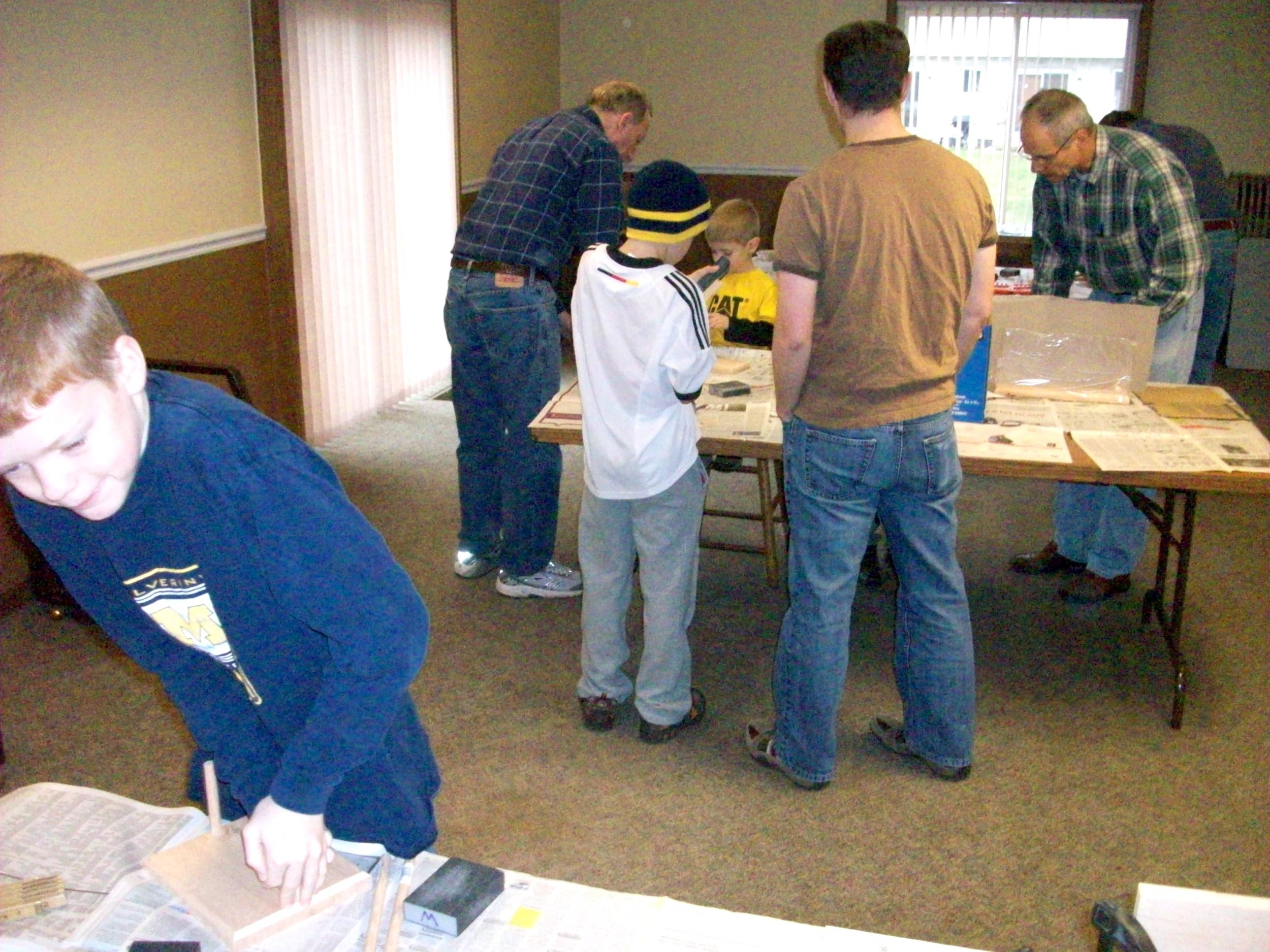 With the Lord speaking to us about being part of bringing His Kingdom on earth as it is in Heaven, the Band of Brothers has been asking, ’what more can we do?’ For the last several years we have met monthly and enjoyed great fellowship, (not a few pancakes!), and shared on topics which have helped us grow as God’s men. Along the way we have learned how to wire a house, shoot a flintlock, operate an MP3 player, brew a perfect cup of coffee—and a perfect pint of beer, join wood, and gaze at the stars, among other topics! We have had a great time and grown, but now we are asking, what can we do to have a Kingdom edge to brotherhood?
 There was a moment in this year’s community Christmas pageant [one of the best ever, by the way, thank Rachael Varblow & Amy Campbell] when the shepherds and angels were all milling around the manger trying to get a look at the baby Jesus. The fact that his part was being played by a real baby provided the motivation for these young method actors. As I Iooked at these representatives of heaven and earth jostling and elbowing for position it occurred to me that this might be closer to that moment in Bethlehem than our usual static tableaux. We read in Luke 2 of the ‘great company of the heavenly host’ praising God and of the shepherds going off to see the baby and to our mind’s eye come the serried rows of a choir and an orderly hike ending in a reverent circle of kneeling shepherds. It may not have been so orderly!
After 2000 years and untold paintings, Christmas cards, crèche scenes and carols the shock value of Jesus’ birth has largely worn off for us. It is hard to imagine just how thunderstruck those shepherds must have been. Sitting quietly by the fire, swapping stories and gossip when KAZAAM!!! the heaven’s open and God’s glory blasts down on them and from the midst of it an angel shouts out his greeting. He could see the impact he was having because the first thing he says is ‘Don’t be afraid’! When they get over the shock of the first angel, a whole mob of them (biblically known as a ‘great company') belt out their message – and then are gone. As they are recovering their wits the shepherds begin to remember what they were told and then they realize this is all wrong! Hallelujah, the Messiah has come! Angels are proclaiming his arrival – that is as it should be. But what is this about the baby wrapped and lying in a manger, that can’t be right. He is the great king, greater than David. Where is the palace, where are the courtiers, where is the earthly glory? They rush off to see and I imagine that their curiosity and confusion caused them to press in for a really good look and press Mary and Joseph for explanations about who this baby was.
There was a moment in this year’s community Christmas pageant [one of the best ever, by the way, thank Rachael Varblow & Amy Campbell] when the shepherds and angels were all milling around the manger trying to get a look at the baby Jesus. The fact that his part was being played by a real baby provided the motivation for these young method actors. As I Iooked at these representatives of heaven and earth jostling and elbowing for position it occurred to me that this might be closer to that moment in Bethlehem than our usual static tableaux. We read in Luke 2 of the ‘great company of the heavenly host’ praising God and of the shepherds going off to see the baby and to our mind’s eye come the serried rows of a choir and an orderly hike ending in a reverent circle of kneeling shepherds. It may not have been so orderly!
After 2000 years and untold paintings, Christmas cards, crèche scenes and carols the shock value of Jesus’ birth has largely worn off for us. It is hard to imagine just how thunderstruck those shepherds must have been. Sitting quietly by the fire, swapping stories and gossip when KAZAAM!!! the heaven’s open and God’s glory blasts down on them and from the midst of it an angel shouts out his greeting. He could see the impact he was having because the first thing he says is ‘Don’t be afraid’! When they get over the shock of the first angel, a whole mob of them (biblically known as a ‘great company') belt out their message – and then are gone. As they are recovering their wits the shepherds begin to remember what they were told and then they realize this is all wrong! Hallelujah, the Messiah has come! Angels are proclaiming his arrival – that is as it should be. But what is this about the baby wrapped and lying in a manger, that can’t be right. He is the great king, greater than David. Where is the palace, where are the courtiers, where is the earthly glory? They rush off to see and I imagine that their curiosity and confusion caused them to press in for a really good look and press Mary and Joseph for explanations about who this baby was.